







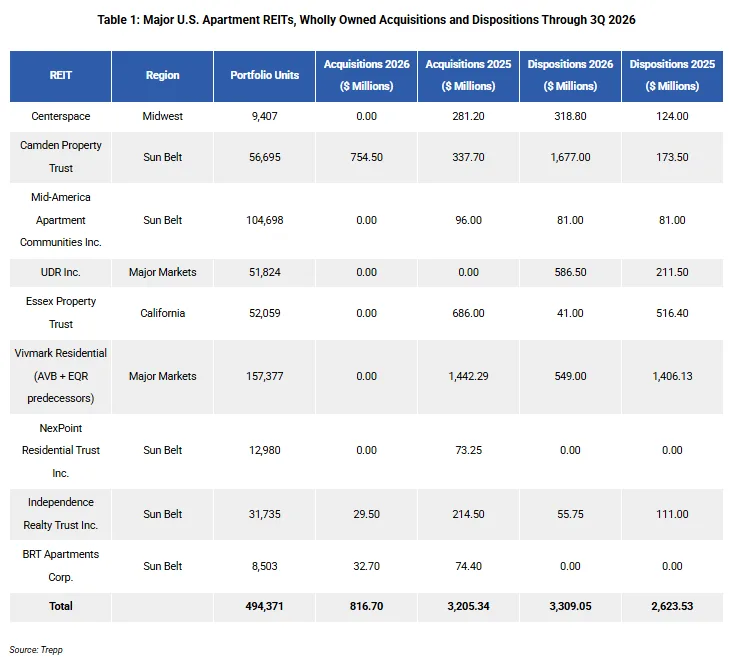
- The nine largest apartment REITs sold $3.31 billion of property through Q3, up 26.1%, while acquisitions fell to $816.7 million from $3.21 billion a year earlier.
- Same-store rents averaged $1,926, up 1.9% year over year, but renewals are growing faster than new-lease rates, and concessions remain sticky.
- Most REITs raised guidance on moderating supply and record retention, though weak new-lease pricing and flat occupancy suggest the recovery remains uneven.
Through Q3 2026, the nine largest U.S. apartment REITs unloaded $3.31 billion of assets and bought just $816.7 million, according to Trepp research.
That is 26.1% more than the $2.62 billion sold a year earlier, while purchases collapsed from $3.21 billion. Together the nine REITs own 494,371 units.
Get Smarter about what matters in CRE
Stay ahead of trends in commercial real estate with CRE Daily – the free newsletter delivering everything you need to start your day in just 5-minutes
Camden Drives the Totals
Camden Property Trust was both the largest buyer and the largest seller. It bought $754.5 million, about 92% of the group’s purchases, and sold $1.68 billion.
The biggest piece was a July deal that sent 11 California communities, 3,620 units in all, to BlackRock for $1.63 billion. Camden said it could not agree with sellers on several deals after pushing for lower prices, and favored share repurchases instead.
Why Buying Slowed
With rates up and cap rates widening, deals penciled out less often. Mid-America Apartment Communities has largely avoided acquisitions in favor of development where returns beat its cost of capital.
UDR used dispositions to shed properties with heavy capital needs and weaker rent growth. Vivmark Residential, the biggest portfolio at 157,377 units, sold $549 million and bought nothing this year, versus $1.44 billion of purchases in 2025.
Rents Up, With a Catch
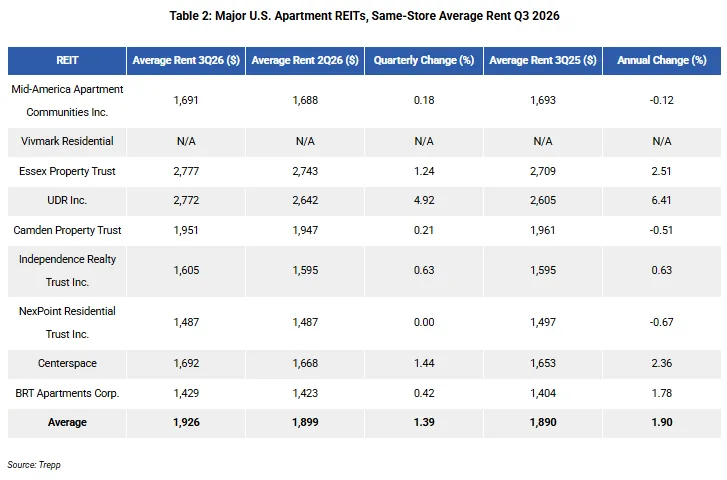
Among the eight REITs that report same-store rent, the mean reached $1,926 in Q3: 1.9% higher year over year and 1.39% above Q2. UDR’s 6.41% jump partly reflects a leaner same-store base after sales: 44,765 units now versus 54,915.
Renewals are doing the work. MAA reported renewal rents up 5.3% while new-lease rates fell 6%, and Camden saw renewals up 3.6% against a 2% drop for new leases. Camden’s Alex Jessett called concessions remarkably sticky, with three weeks to two months free.
Occupancy Slips Slightly
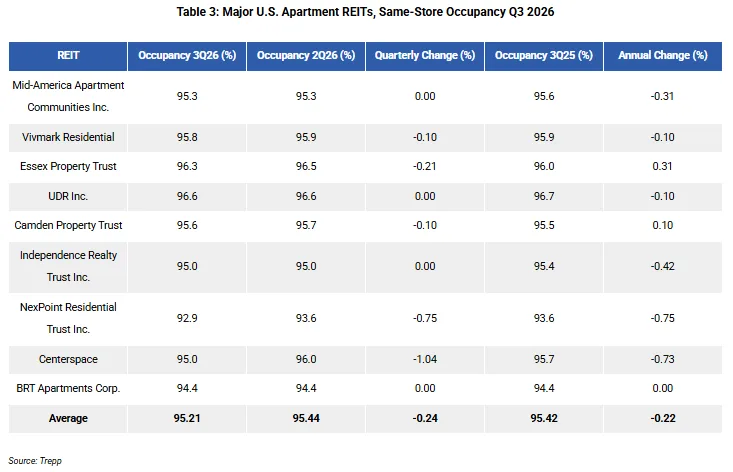
Average occupancy was 95.2% versus 95.4% a year earlier. Centerspace fell 100 basis points to 95% and NexPoint dropped 70 basis points to 92.9%, while most others barely moved.
Why It Matters
This fits our earlier read that apartment REITs split as renewals carried Q3 and the Sun Belt lagged. The Sun Belt names in this data, Camden and MAA, are also where rent growth has been weakest.
We also reported that MAA trimmed guidance as Sun Belt rent recovery lagged, which matches the selective stance in the Trepp numbers.
What’s Next
Most of the REITs lifted guidance, pointing to easing supply, record retention and stronger lease spreads. Soft pricing on new leases and lingering concessions keep the rebound uneven.