








- Scheduled commercial mortgage maturities total $875B in 2026, down from $957B in 2025, but rising base rates have put upcoming maturities back in focus, Newmark found.
- About 78% of fixed-rate securitized CRE debt due through 2028 carries a coupon well under the 10-year Treasury yield, and more than 40% of properties recently sold below prior prices.
- Lenders are shifting from extending troubled loans toward recognizing losses, so borrowers can no longer rely on lower rates to refinance, and CMBS delinquency has reached 7.85%.
Commercial mortgage maturities are shrinking on paper, with $875B due in 2026 versus $957B in 2025, but rising base rates have put the maturity wall back in focus.
About 78% of the fixed-rate securitized CRE loans that come due through 2028 pay coupons far under today’s 10-year Treasury yield, leaving $179B in exposed debt, according to Newmark research.
Get Smarter about what matters in CRE
Stay ahead of trends in commercial real estate with CRE Daily – the free newsletter delivering everything you need to start your day in just 5-minutes
Old Loans Meet New Rates
Most of these loans were written when rates sat near historic lows and property values were close to their peak. The risk has been discussed since 2023, but two conditions differ now.
Per the research, investors anticipate rates staying high, and lenders are retreating from extend-and-pretend, the tactic that carried the past four years.
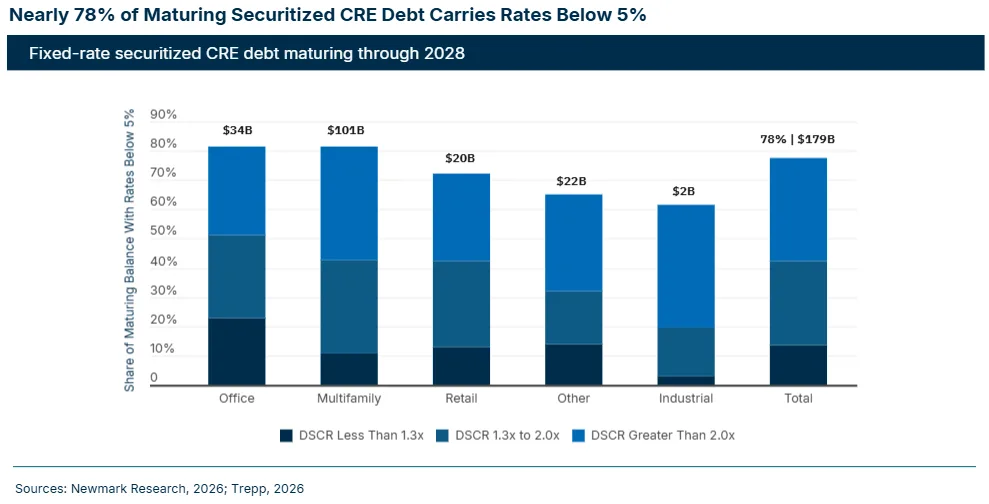
By property type, multifamily carries the most exposure at $101B, followed by office at $34B, other property types at $22B, retail at $20B and industrial at $2B, per the report’s chart.
Why Waiting Fails
The timing of further hikes is unclear, but markets increasingly price in borrowing costs that rise and stay high. A term premium is also propping up longer-term Treasury yields, whatever the Fed does with short-term rates.
The report’s bottom line for borrowers: a rate drop can’t be the plan, because holding out for cheaper money has stopped working as a way to refinance.
Stress Shows Up in CMBS
CMBS delinquency overall hit 7.85% in August, per the CRE Finance Council’s monthly loan performance report. Non-performing matured loans made up 81% of newly delinquent balances, which makes defaults at maturity a major source of fresh delinquency and the trigger for forced action on weak assets.
Multifamily, the largest slice of the exposure, is under strain too. Per Trepp data in our earlier coverage, there was $11.6B of delinquent loans across $635.82B of securitized multifamily debt in August, with private-label CMBS at a 7.69% delinquency rate.
Distress Moves to the Closing Table
Costlier financing and lower valuations leave less room to extend or refinance, so sales are absorbing more of the distress. Across asset classes, over 40% of properties traded in the last year changed hands below their prior sale prices after adjusting for inflation, per the report.
The picture is owners and lenders slowly shifting away from extensions and toward taking losses, with values repriced for current borrowing costs.
Why It Matters
Sponsors who relied on extensions now face a choice between fresh equity, a sale or a recapitalization. The pressure fits what we have seen in CMBS hard maturities, where October’s cohort hit $4.70B, up from $2.74B in September, with 27.74% of the balance severely impaired on a debt yield below 6.0%, per Trepp.
It also fits the multifamily refinance gap we covered after the September rate hike. CRED iQ re-sized $136B of agency and CMBS apartment debt due through December 2028 and found 31% of the balance needs $6.8B of new equity, with each further 25 basis points of hikes adding roughly $1B.
What’s Next
Pressure should build as more of the $179B comes due through 2028. Watch whether lenders keep shifting toward loss recognition, and whether more sales below prior marks reset valuations.
One caution from our earlier coverage of Trepp data: stated maturities likely overstate what must refinance in any given year, because many near-term loans have extension options or were already modified. That makes the retreat from extensions the variable to track.