






- With the 10-year Treasury yield at levels last seen in 2002, buyers want higher cap rates and sellers want yesterday’s prices, so large REIT acquisitions are being reset or paused.
- REITs trade at roughly a 10% discount to net asset value, versus 15% to 30% in recent years, which leaves most too cheap to buy with and too expensive to take over.
- Healthcare REITs trading at premiums to NAV, including Welltower at roughly 97%, hold a funding edge, while deeply discounted office and apartment REITs could become takeover targets.
Surging Treasury yields are pulling REIT M&A into a slowdown, according to Bisnow. With the 10-year yield at levels last seen in 2002, executives and analysts say buyers and sellers cannot agree on pricing.
That gap is stalling acquisitions across nearly every property type.
Get Smarter about what matters in CRE
Stay ahead of trends in commercial real estate with CRE Daily – the free newsletter delivering everything you need to start your day in just 5-minutes
Pricing Gap Freezes Deals
Haendel St. Juste, a REIT analyst at Mizuho Americas, said after Mizuho’s annual digital REIT conference that REIT managements told him their acquisitions are taking a pause. Buyers want higher cap rates because their cost of capital rose, he said, while sellers still want prices from when debt was cheaper.
REITs now trade at roughly a 10% discount to net asset value on average, according to Hoya Capital. That is narrower than the 15% to 30% discounts that defined the sector in recent years.
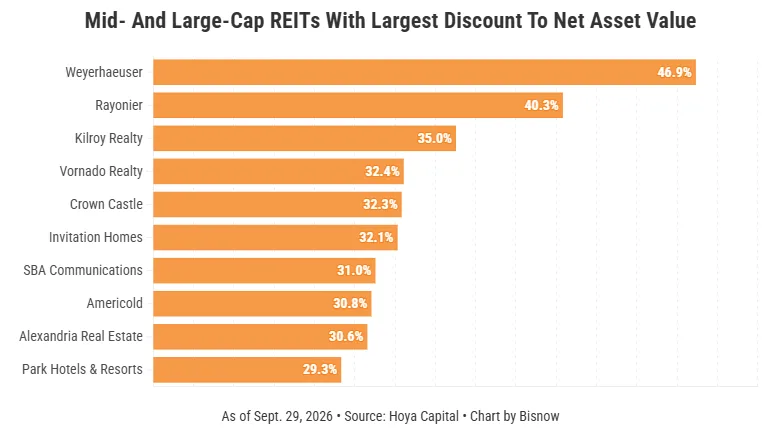
Stuck in No-Man’s-Land
The tighter gap leaves REITs in an awkward spot. They are not cheap enough to attract buyers, and not valued richly enough to act as buyers themselves.
Alex Pettee, director of research and ETFs at Hoya Capital, said M&A is likely to stay in a holding pattern until REITs gain enough value to buy or fall far enough to become buyout targets. Seth Laughlin of Cohen & Steers said rates need some stability before activity accelerates, especially take-privates.
Laughlin added that public markets show too little price divergence within asset classes to make public-to-public deals attractive. This year’s takeouts have focused on adding scale to unlock value rather than on value-add acquisitions.
Big Deals Still Got Done
A handful of large transactions have lifted M&A totals even as deal counts stay muted. AvalonBay Communities and Equity Residential completed an all-stock merger in August that created Vivmark, a 180,000-unit REIT with a $69B enterprise value.
Public Storage agreed to a $10.5B all-stock acquisition of National Storage Affiliates Trust. Independence Realty Trust plans to combine with Centerspace in an all-stock deal creating a 44,000-apartment REIT valued at $8.1B, though a minority shareholder wants IRT to consider selling itself.
Bisnow counts at least a dozen other REITs that merged with competitors or went private over the past 12 months.
Who Trades Cheap, Who Trades Rich
Hoya is tracking at least 30 REITs trading at NAV discounts of 20% or more. Nine REITs with market caps of at least $3B trade at discounts of 30% or more, including office REITs Kilroy Realty and Vornado Realty Trust. Park Hotels & Resorts sits just under that threshold.
UDR, Vivmark and Mid-America Apartment Communities each trade at discounts of at least 22%.
At the other end, healthcare REITs carry premiums. Welltower trades at about a 97% premium to NAV, American Healthcare REIT at 56%, Ventas at 35% and senior housing REIT Janus Living at roughly 35%, according to 2nd Market Capital.
Why It Matters
Premium-priced healthcare REITs can keep buying, with Laughlin noting senior housing yields are higher and the pullback from private competition helps. Most other REITs lack that currency, which concentrates consolidation among a few sectors.
Public markets have already repriced after the sell-off, a theme in the recent REIT returns data. Private values have not moved as quickly.
What’s Next
Pettee framed it simply: rates set the backdrop, but the NAV discount determines the flow of funds and assets. A big enough discount can overwhelm higher borrowing costs, as it did when REITs traded at 20% to 30% discounts.
If REITs hold their valuations, they keep stronger balance sheets than much of the private market. If they slide lower, they become takeout candidates for private operators.