



- Average availability across Manhattan’s prime retail corridors dropped to 11.4% in Q3 2026, the lowest reading since JLL began tracking in 2017, with only 157 spaces left.
- Bank of America, OceanFirst and Citibank signed leases totaling nearly 35,000 square feet, and JLL says many more bank deals are pending, adding fresh competition for storefronts.
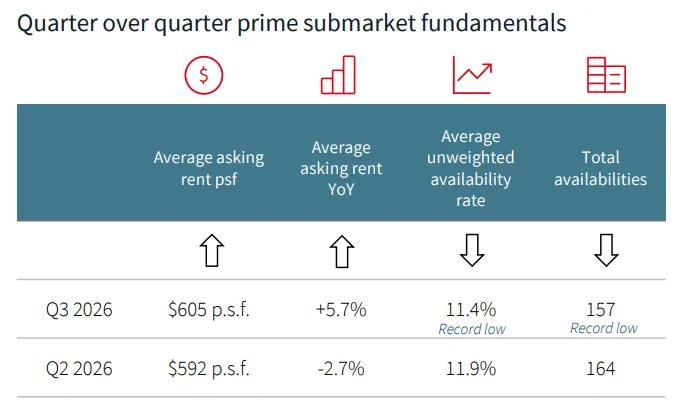
- Asking rents averaged $605 per square foot, up 5.7% year over year, so retailers face fewer options and higher occupancy costs unless they search more selectively.
Average availability across Manhattan’s prime retail corridors fell to 11.4% in the third quarter of 2026, the lowest since JLL began tracking in 2017, as retail bank branches took space off the market.
Just 157 spaces remain available, 38 fewer than a year ago, while average asking rents rose 5.7% year over year to $605 per square foot, according to JLL’s Q3 2026 Manhattan retail report.
Get Smarter About What Matters in New York
Subscribe to our free newsletter covering the biggest commercial real estate stories across the five boroughs — delivered in just 5 minutes.
Banks Join the Storefront Hunt
JLL names increased bank activity as one of the main reasons supply keeps shrinking. Bank of America leased 16,309 square feet at 19 Union Square West, OceanFirst took 4,100 square feet at 36 Union Square East, and Citibank signed for 14,274 square feet at 170 West 72nd Street.
Those three deals total nearly 35,000 square feet, and JLL says many more bank transactions are pending.
Patrick A. Smith, vice chairman at JLL, said everyday banking may happen on a phone, but a branch gives a bank a neighborhood presence and a place to sit down with customers about bigger financial decisions.
Where Manhattan Retail Availability Fell Furthest
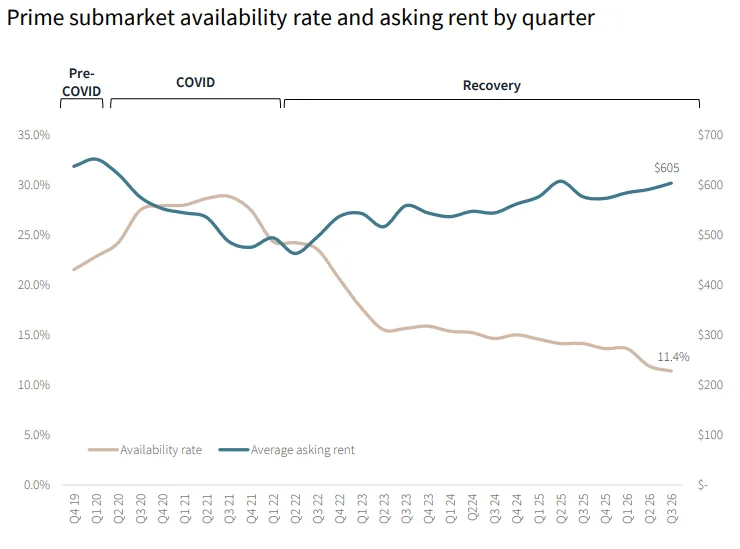
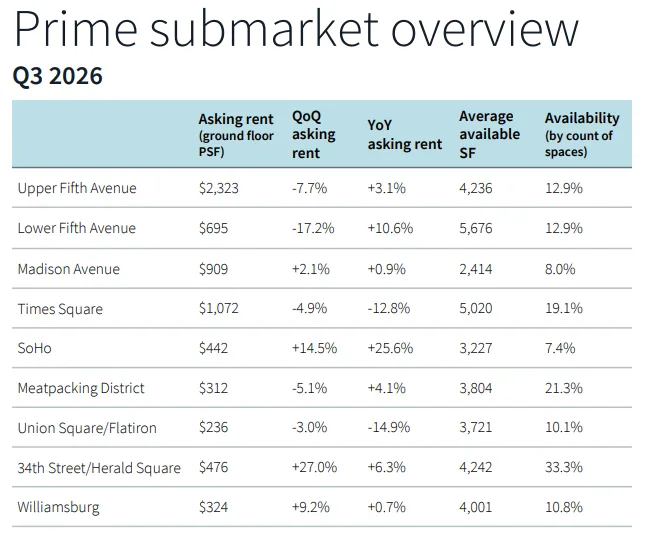
Five prime submarkets posted net decreases in availabilities: Lower Fifth Avenue, Times Square, SoHo, Union Square/Flatiron and 34th Street/Herald Square. SoHo set a record low availability rate of 7.4%, and Union Square/Flatiron reached 10.1%, tying its Q2 2018 record.
JLL attributes the drop to subleases leaving the market and stronger leasing from bank tenants. The total count of availabilities fell by seven from Q2, when the average rate was 11.9%.
The longer view is starker. Average annual prime availability has dropped from 21.4% in 2019 to 12.3% in 2026.
Rents Climb, With Gaps
The average prime asking rent rose from $592 per square foot in Q2 2026 to $605 in Q3. That sits just below the post-COVID peak of $608 set in Q2 2025 and still trails the $638 average from Q4 2019.
Not every corridor moved up. SoHo, Madison Avenue and 34th Street/Herald Square raised asking rents from Q2, while Upper and Lower Fifth Avenue each fell by more than $100 per square foot.
JLL reads the Fifth Avenue declines as a sign that the remaining spaces are less desirable than those recently leased.
SoHo’s ground-floor asking rent averaged $442 per square foot, up 25.6% year over year, while Times Square fell 12.8% to $1,072 and Union Square/Flatiron slid 14.9% to $236.
Demand Stays Broad but Uneven
Other tenants kept signing. Glasshouse leased 66,436 square feet for event space at 3 World Trade Center, Burlington took 31,717 square feet at 25 Navy Street, and the private club Maison Estelle signed for 30,000 square feet at 656 Avenue of the Americas.
Elsewhere, Zara leased 22,060 square feet at 184-192 Bedford Avenue in Williamsburg, and UGG took 12,818 square feet at 620 Fifth Avenue. In the Meatpacking District, Japan’s Roland Corporation leased 9,000 square feet for a music store, and London’s Annabel membership club bought 675 Hudson Street for $100 million.
JLL’s read of consumer conditions is mixed. Spending rose slightly on strength at the high end, particularly luxury, while mid-tier sales growth reflected higher prices rather than more volume, and elevated energy and fuel costs squeezed margins.
Why It Matters
Smith said the lowest availability since 2017 means fewer choices for retailers pursuing a growth strategy in New York. Finding the right space at an occupancy cost a business can support now takes a more focused search.
Banks are a big reason. “Banks have also made substantial leasing commitments this quarter, taking significant space off the market,” Smith said. They add another source of competition for storefronts at a time when retailers already have fewer options.
What’s Next
With more bank deals pending, watch whether availability extends its record-low run next quarter. Also watch whether asking rents clear the $608 post-COVID peak and whether tenants keep looking beyond prime blocks, as several Madison Avenue tenants have by leasing north of the core stretch.