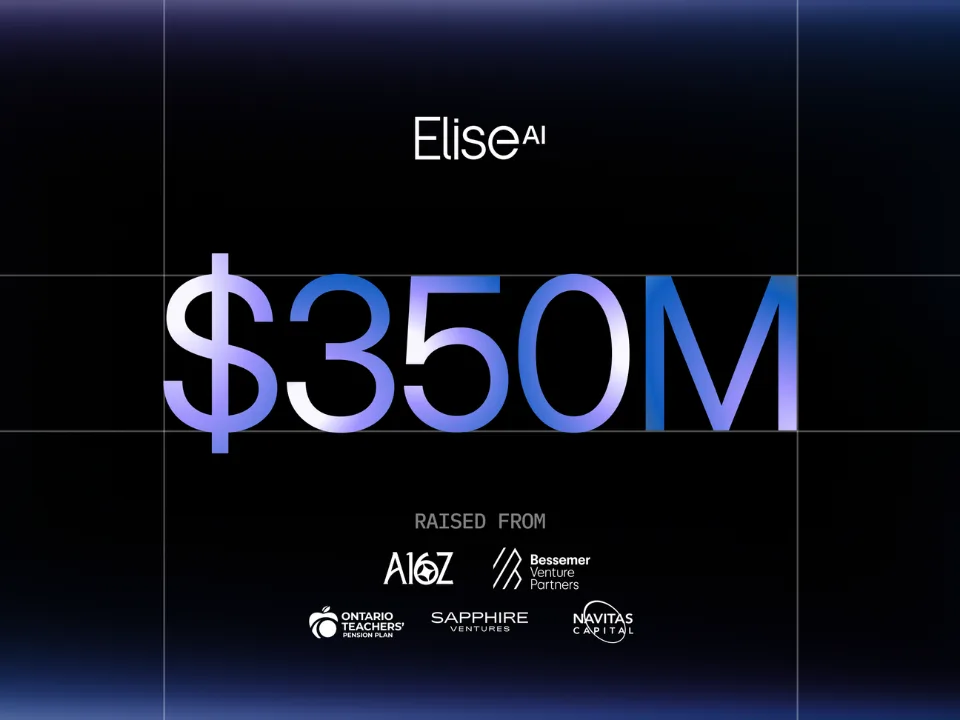





- EliseAI closed a $350 million round at a $4 billion valuation, led by Andreessen Horowitz and Bessemer Venture Partners, to push its automation further into housing and healthcare.
- The New York-based company reported $200 million in annual recurring revenue as of June 2026, after five straight years of doubling revenue year over year.
- The deal is one of 2026’s largest proptech raises and reinforces how venture capital is concentrating in a small group of scaled AI platforms instead of early-stage bets.
EliseAI closed a $350 million round at a $4 billion valuation, according to a September 29 announcement from the New York-based company. Andreessen Horowitz and Bessemer Venture Partners led the raise.
EliseAI plans to use the capital to automate more of the day-to-day work behind apartment operations and specialty healthcare practices, two industries it argues technology has largely underserved.
Get Smarter about what matters in CRE
Stay ahead of trends in commercial real estate with CRE Daily – the free newsletter delivering everything you need to start your day in just 5-minutes
Built Inside Apartment Operations
EliseAI’s housing product covers the full resident lifecycle: leasing, resident communications and services, maintenance, billing, and renewals. The company says its platform now powers one in six U.S. apartments, and more than 30 million Americans have interacted with it.
Earlier in September, EliseAI launched Apollo, which it describes as an agentic AI teammate. Apollo runs inside operators’ existing property management systems and can complete any task on the EliseAI platform end to end, rather than handing work back to onsite staff.
The Details
Ontario Teachers’ Pension Plan, Sapphire Ventures, and Navitas Capital also joined the round. EliseAI reported $200 million in annual recurring revenue as of June 2026, capping five consecutive years of 100% year-over-year revenue growth.
The company will put the money toward expanding automation, growing its engineering and deployment teams, and building San Francisco into a second engineering hub alongside its New York headquarters. It also has teams in Boston, Chicago, Austin, and Toronto.
On the healthcare side, EliseAI sells to specialty physician groups, automating tasks across the patient journey.
Big Checks in a Selective Proptech Market
The round lands in a market where investors are writing fewer, larger checks. Global proptech venture funding totaled $4.53 billion across 231 deals in the first half of 2026, down 0.6% from a year earlier and roughly 65% below the 2021-2022 peak, according to Creti’s H1 2026 Global Proptech Venture Report.
Eleven mega-rounds of $100 million or more captured 49.6% of that capital, per Creti. EliseAI’s single raise equals nearly 8% of the entire first-half total, and its $4 billion valuation sits well above the $2.5 billion Flow commanded on its own $100 million round.
Why It Matters for Multifamily AI
At one-in-six penetration, EliseAI has moved well past the pilot stage and is already embedded in the leasing and service workflows of a significant share of the U.S. rental stock, and Apollo signals a shift from answering prospect inquiries to actually executing work inside the property management system.
Bessemer partner Sameer Dholakia credited the company’s mix of AI research and engineering with a detailed understanding of how properties operate. The investors framed housing and healthcare as two of the largest household expenses in the U.S., both marked by thin margins and heavy regulation.
The planned San Francisco hub and hiring across six cities also add to the AI-driven office demand that has helped fuel an office recovery in New York.
What’s Next
The key test is Apollo. If operators hand it end-to-end tasks like maintenance coordination and renewals, the conversation around multifamily AI shifts from response times to onsite staffing models.
Watch for how quickly EliseAI builds out its San Francisco engineering team, and whether its healthcare business begins to approach the scale of its housing platform. With $350 million in fresh capital, the company has room to keep outspending smaller multifamily AI vendors on product and deployment.