




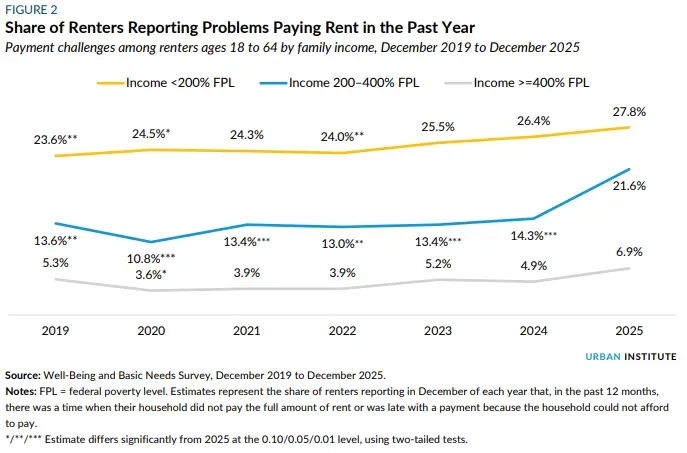
- One in five renter households paid rent late or missed a payment in 2025, up from 16.5% in 2024, according to Urban Institute research.
- Middle-income renters reporting rent problems jumped from 14.3% to 21.6%, the largest year-over-year increase among income groups.
- Utility pressure remained elevated, with 20.7% of renters unable to pay the full amount of heating and electricity bills.
Multifamily Dive reports in its coverage of new Urban Institute research that middle-income renters faced a sharp increase in payment problems in 2025. One in five renter households paid rent late or missed a payment. That was up from 16.5% in 2024. The Urban Institute said the 2025 share was the highest since researchers began tracking the measure in 2017.
Get Smarter about what matters in CRE
Stay ahead of trends in commercial real estate with CRE Daily – the free newsletter delivering everything you need to start your day in just 5-minutes
Middle-Income Renters See More Stress
The largest year-over-year increase came from middle-income renters. The study defined that group as households earning 200% to 400% of the federal poverty line. Their reported rent affordability challenges rose from 14.3% in 2024 to 21.6% in 2025. Nearly 28% of low-income households also reported difficulty paying rent. Urban Institute researcher Kathryn Reynolds said the middle-income increase is important because those households usually have more choices. They also tend to have more buying power in the rental market. Greater stress in that group can increase competition for lower-cost units.
The Details
The study examined working-age renters and homeowners from 2019 through 2025. It also found 20.7% of renters could not pay the full amount of heating and electricity bills in 2025. That share was similar to 2023 and 2024. It was still above levels recorded from 2019 through 2022. Researchers said utility-payment problems were lower between 2020 and 2022. They said pandemic-era stimulus payments and safety-net expansions may have contributed to that temporary improvement. The latest results point to rent and utilities straining the same household budgets.
Affordability Pressure Spreads Across Regions
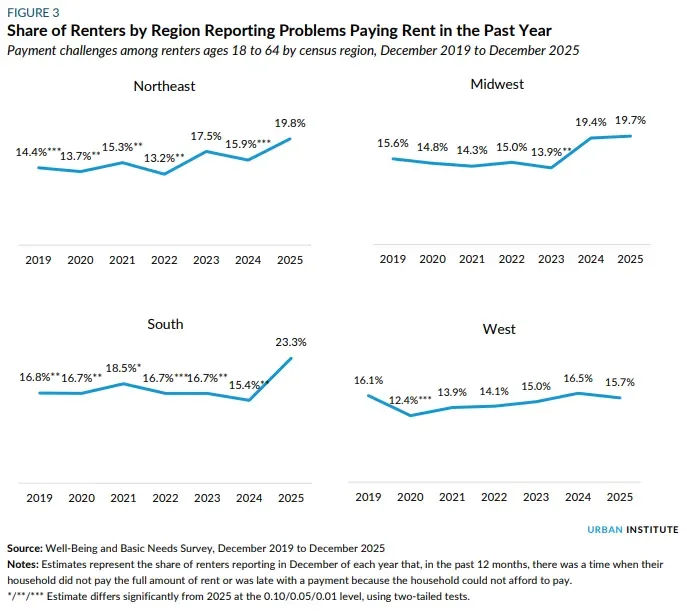
Rent-payment difficulty was higher in 2025 than in prior years across the Northeast, Midwest, and South, according to the study. The West was the only census region without a significant increase. Reynolds said some Sun Belt markets may still be relatively affordable compared with other parts of the country. Late-rent trends already show financial strain among US renters. The new research suggests that pressure is moving further up the income distribution. That can change which households compete for the same apartments.
Why It Matters
Researchers described rent and utility problems as one interconnected affordability challenge. Reynolds said middle-income renters under pressure may compete for units that would otherwise be affordable to lower-income households. That can push stress down the market. Apartment owners may also face harder operating choices around collections, payment plans, and turnover. Reynolds encouraged owners to communicate with struggling tenants. She also said operators should remain as flexible as property finances allow. Replacing residents can be costly, so avoiding unnecessary turnover may benefit both sides. The study treats the rental market as one ecosystem. When households with more income move down the price ladder, lower-income renters can face more competition for the same units. That makes payment stress relevant to both affordability and occupancy management.
What’s Next
The Urban Institute called for policy responses at multiple levels of government, including measures that support housing stability and new supply. Reynolds said local and state governments can keep encouraging development through borrowing-cost subsidies or additional assistance. She also pointed to potential supply-side tools in the ROAD to Housing law. At the same time, higher borrowing costs raise the subsidy needed for each affordable unit. Reynolds said more housing still needs to be built where it is needed and at workable price points. Owners will continue balancing tenant flexibility with property-level financial constraints. She also noted that inflation has raised borrowing costs, increasing the subsidy required for each affordable housing unit just as demand for lower-cost housing grows.