



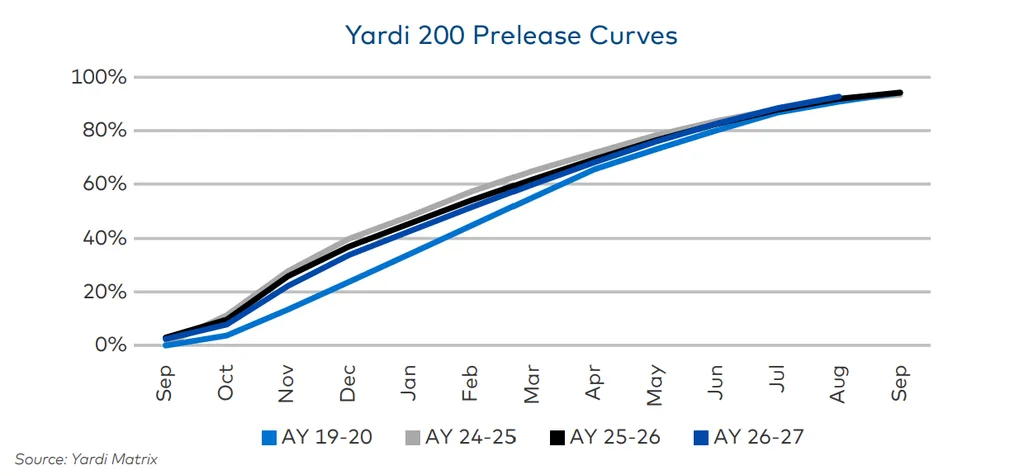
- Yardi 200 schools reached 93% preleased in August, 80 basis points above the final August 2025 estimate.
- Class A properties reached 93.8% preleased, while properties more than two miles from campus trailed at 88.7%.
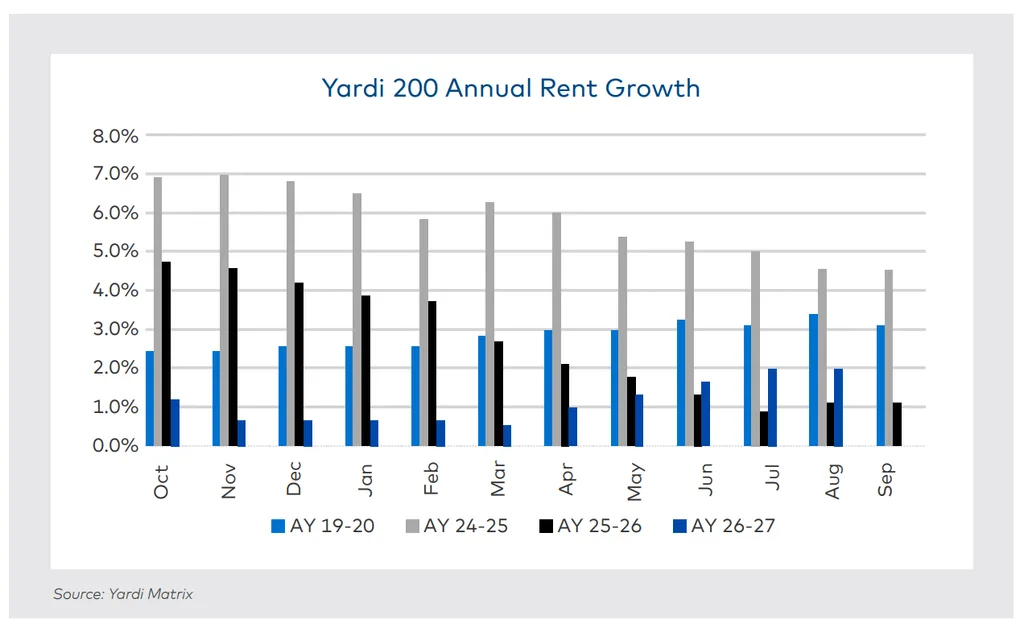
- Leasing-season rent growth averaged 1.1%, down from 2.8% last year, even as advertised rents held 2% above August 2025.
Yardi Matrix says student housing preleasing remained strong for the 2026-27 academic year even as rent growth lost momentum. Its September student housing market report put August preleasing across the Yardi 200 at 93%. That was 80 basis points above Yardi’s final August 2025 estimate. It was also 120 basis points above August 2024. Nearly 320 properties reported being fully preleased, slightly more than at the same point last year.
Get Smarter about what matters in CRE
Stay ahead of trends in commercial real estate with CRE Daily – the free newsletter delivering everything you need to start your day in just 5-minutes
Quality and Campus Proximity Lead
Class A properties posted the strongest performance at 93.8% preleased in August. Class B reached 92.1%, while Class C was 91.7%. Location also mattered. Properties within 0.25 miles of campus were 93.4% preleased. Those between 0.25 and 0.5 miles reached 93.2%. Both were about 100 basis points ahead of August 2025. Properties more than two miles away were only 88.7% preleased. That group trailed last year by 110 basis points.
The location advantage extended beyond leasing velocity. Properties closest to campus also led rent growth this season, reversing the pattern of the previous two years. In 2025-26, properties one to two miles from campus led with 4.5% growth. Properties more than two miles away led in 2024-25 with 9% growth.
The Details
Yardi expects the 93% preliminary reading to be revised once final occupancy is confirmed. Based on prior revisions, final occupancy should reach about 94% to 94.5%, similar to last year. Twenty-eight Yardi 200 markets were reportedly 100% preleased. Another 11 exceeded 99%. Auburn, Maryland, Mizzou, Virginia, and Virginia Tech were among the large markets with near-full leasing. With the exception of Mizzou, those strong markets have also attracted new supply. Yardi said each of those schools had about 1,600 beds under construction on average.
Several previously weaker markets also rebounded. The 20 schools with the largest year-over-year gains averaged 95.6% preleasing in August. Nine had failed to reach 90% occupancy at the start of 2025-26. Five had remained below 90% for at least two years, including Missouri State, Washington State, Temple, East Carolina, and UT-Arlington. Kent State posted the largest year-over-year improvement at 15 percentage points. UNC Wilmington followed at 14.1 points, while Missouri State improved 12.2 points.
Laggards Face New-Supply Pressure
The market still has a sizable weak tail. Fifty-two Yardi 200 schools were below 90% preleased, including 21 below 80%. Utah Valley was 71.1%, Syracuse 77.9%, Delaware 78.7%, and North Carolina State 78.8%. All four were well behind August 2025. NC State trailed by 18.2 percentage points after 2,195 new beds delivered in August. Two additional projects there will add 970 beds in 2027.
The weakness was broader than those four markets. Twenty-three schools were at least 10 percentage points behind last year’s preleasing pace. Among large student housing markets, Purdue was 85.1% preleased, down 8 points year over year. Arizona State stood at 87.3%, down 5.9 points. Texas A&M was 89.3%, down 2.1 points, with another 5,365 beds under construction.
Why It Matters
Strong occupancy is no longer translating into the rent growth seen earlier in the cycle. Advertised rents fell 0.2% month over month to $927 per bed in August, the lowest level since January. That was down from $929 in July and $930 in June. Year-over-year growth remained at 2%, partly because rents also declined for five consecutive months beginning in April 2025.
Leasing-season rent growth averaged 1.1%. That compares with 2.8% for 2025-26 and 5.9% for 2024-25. Same-store growth has averaged just 0.4% since October 2025, showing that new properties in lease-up are lifting the broader average. The pattern extends the student housing market’s shift toward strong preleasing but slower rent gains. Properties within 0.25 miles of campus averaged 1.6% growth. Properties more than two miles away declined 1.2%.
Rent Growth Diverges by Market
Even strong leasing markets are seeing slower pricing gains. Auburn led major student markets with 7.9% average rent growth this season, down from 10.4% previously. Mizzou reached 7.7%, below 8.9% last year. Ole Miss slowed to 7% from 22.1%. Still, the national slowdown is not universal. Average leasing-season rent growth improved across 72 Yardi 200 markets. Nevada-Reno averaged 6.1% growth after a 0.6% decline last year. Minnesota and Georgia Tech remained negative at 0.5% and 0.9% declines, respectively, but both improved substantially from last season.
Other markets moved sharply in the opposite direction after several years of stronger growth and new development. Northern Arizona rents declined an average of 8.2% this season after staying flat last year and rising 8.5% in 2024-25. Purdue fell 8.1% after gains of 7.6% and 13.4% in the prior two seasons. Arizona declined 6.8% after increasing 2.5% last year and 9.8% two years ago.
The differences are also visible in absolute rents. Among the major markets tracked by Yardi, Washington had the highest August rent at $1,600 per bed. Michigan followed at $1,564, while Wisconsin reached $1,396. Texas Tech was at the other end of the group at $612 per bed, despite improving preleasing by 5.8 percentage points year over year.
What’s Next
Enrollment trends add another variable. Among 38 Yardi 200 schools with fall 2026 data, enrollment grew by 6,840 students, or 0.6%, to 1.08M. Growth was 1.8% in fall 2025. Yardi cited declining international enrollment as one contributor. Arizona State-Tempe fell 7.4%, and North Texas declined 3.6%. Both schools have relatively high shares of international undergraduate students.
Other schools continue to expand. Texas Tech enrollment increased 9.2%, Georgia Southern rose 7.6%, and Texas State grew 7%. All three posted strong gains for a second consecutive year. The next occupancy revisions will show whether current preleasing strength holds after move-ins. Supply-heavy schools will be especially important to watch as new beds compete against slower enrollment and more limited rent growth.