




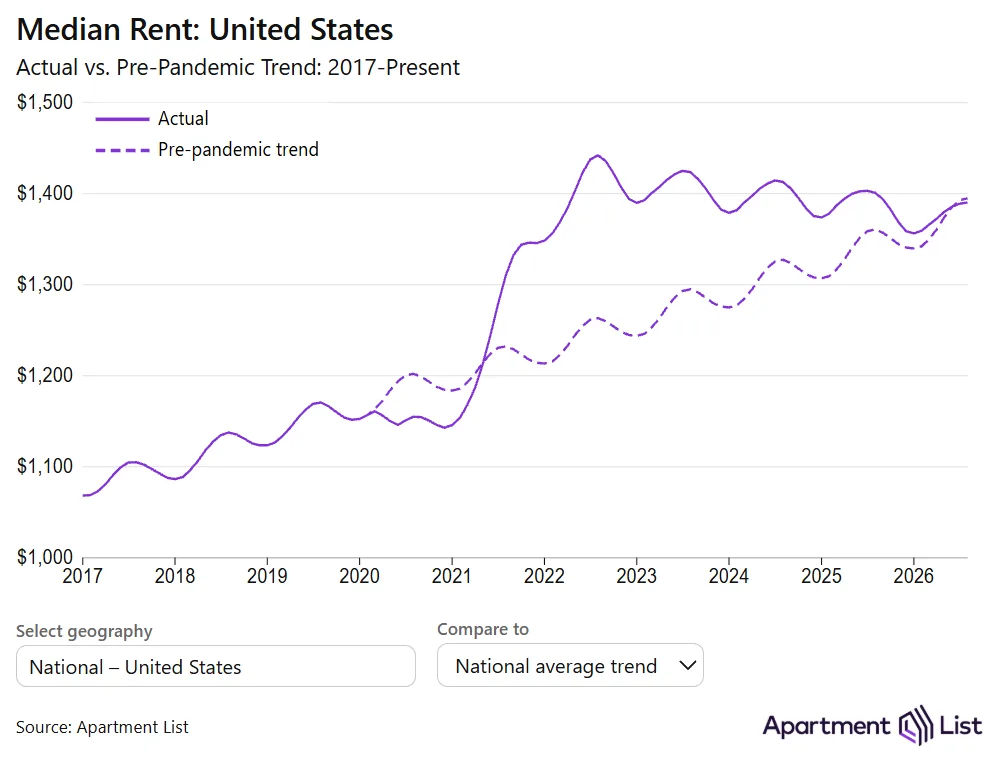
- Apartment List put the August 2026 national median rent at $1,390, just $5 below its pre-pandemic trend projection.
- National rent growth since 2020 has averaged about 2.5% annually after the pandemic surge and later declines offset each other.
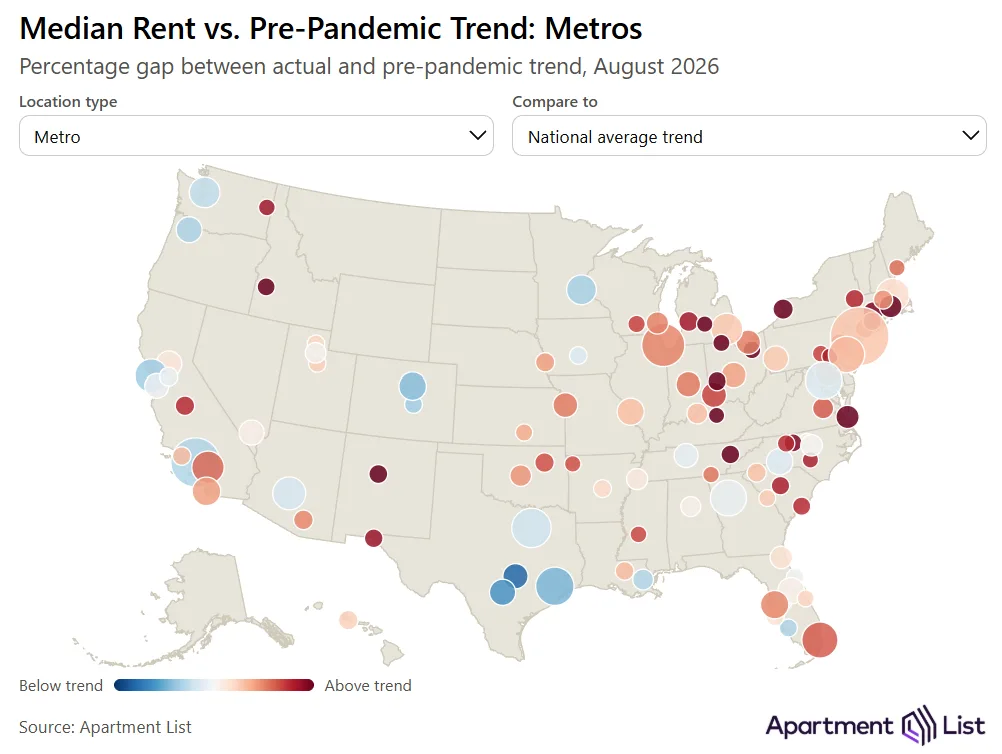
- Buffalo sits far above trend while Austin remains below it, showing how much national rent data can mask local conditions.
Apartment List says the national median rent has almost fully returned to its pre-pandemic growth path. Its analysis of long-run rent trends compares current rents with a steady historical baseline. The August 2026 median was $1,390. Apartment List’s steady 2.5% growth path implied $1,395 for the same month. That convergence follows years of extreme swings in both directions.
Get Smarter about what matters in CRE
Stay ahead of trends in commercial real estate with CRE Daily – the free newsletter delivering everything you need to start your day in just 5-minutes
The Details
The pre-pandemic baseline was relatively steady. Apartment List said rents grew 2.5% annually from 2017 through 2019. Average inflation was 2.1%, while wage growth averaged 3.1%. The firm uses that earlier period as a reference point for a stabilized national rental market.
Apartment List calculated that national rent growth averaged 2.5% per year from 2017 through 2019. That pace roughly tracked inflation and wage growth during the period. In 2020, Apartment List put the national median rent 4% below trend. The gap was about $50 per month.
The market then reversed quickly. By August 2022, Apartment List said the median rent was 14% above trend. The gap was about $180 per month. As demand cooled and a historic apartment construction wave reached completion, properties faced more competition for renters. Since 2023, year-over-year national rent growth has remained negative.
Local Markets Tell Different Stories
The national convergence hides major regional differences. Among the 50 largest metros, Apartment List identified Buffalo as the largest positive outlier. Its median rent rose 66% from early 2020 to $1,259. That level is 37% above the national 2.5% trend path. It is 51% above Buffalo’s own pre-pandemic trajectory.
Austin is at the other end of the spectrum. Apartment List put its median rent at $1,300, about 15% below the national pre-pandemic growth path. Apartment List said Austin added more multifamily housing per capita than any other market. Rents have fallen sharply from their 2022 peak. Apartment List put Phoenix 3% below the national trend. It was 25% below the pace implied by its own 2017 to 2019 growth.
Apartment List also found many Northeast and Midwest markets running above the national pre-pandemic trend. Several markets in the South and West remain below it. Apartment List highlighted San Antonio, Houston, Denver and Phoenix.
The geographic pattern extends beyond the largest outliers. Apartment List highlighted Providence, Hartford, Toledo and Lexington among markets running well above the national pre-pandemic trend. San Antonio, Houston, Denver, Phoenix and San Francisco were below that path at the metro level. San Francisco city itself had moved above trend.
Across the markets tracked by Apartment List, roughly half were above the national pre-pandemic path and half were below it. That balance helps explain why the national median can sit almost exactly on trend even when individual metros remain far apart.
Why It Matters
The latest figures show why a national rent index can look stable while individual markets remain far apart. The pandemic boom, the supply wave and the subsequent cooling period occurred at different intensities across metros. As a result, owners and investors still need local supply and demand conditions to interpret headline US rent growth.
Recent multifamily rent growth has been weak even as the national index approaches its long-run level. Apartment List said national rents were down 0.8% year over year in August, but the pace of decline had already begun to moderate.
What’s Next
Apartment List expects the construction boom to keep winding down while occupancy tightens. That combination is gradually returning pricing leverage to property owners. The firm said positive rent growth could return, and 2027 may become the first year since 2019 with low-single-digit growth that resembles a more typical market.
The path will still vary widely by geography. Markets that added large amounts of supply can remain softer even as the national index improves, while constrained markets may continue to run above trend.