



- A GatherGov analysis of 3,433 meeting mentions across 500+ jurisdictions found California’s AB 98 warehouse law driving 57% of all truck route discussion, concentrated in Riverside and San Bernardino counties.
- New and expanded California warehouses must now submit a truck routing plan tied to the city’s official route map before receiving a certificate of occupancy, making truck routes an entitlement issue.
- Moreno Valley’s August 2026 map revision strips residential streets from its route network, concentrating routes in industrial zones, a model other Inland Empire cities are expected to follow before 2028.
A single 2024 California law is reshaping how warehouses get built. AB 98 required the “warehouse concentration region”, Riverside and San Bernardino counties plus 12 Inland Empire cities, to adopt updated truck routes by January 1, 2026, with the rest of the state following by 2028, according to a new analysis of 3,433 public-meeting mentions from GatherGov. That single requirement explains why California accounts for 57% of all truck route discussion nationally and why the eight most active jurisdictions in the dataset are all in the Inland Empire.
Get Smarter about what matters in CRE
Stay ahead of trends in commercial real estate with CRE Daily – the free newsletter delivering everything you need to start your day in just 5-minutes
A Law With a Hard Deadline
Mentions peaked at 348 to 452 per month between October and December 2025 as Inland Empire jurisdictions rushed to adopt compliant routes before the January 1 deadline, then settled to 200 to 340 per month as attention shifted to revisions and enforcement. Ordinance and map updates now account for 35% of all truck route mentions in the dataset, second only to residential complaints about noise and safety at 37%. Warehouse and logistics development approvals make up another 29%, reflecting how often route discussions now surface inside planning commission hearings on specific projects.
The Details
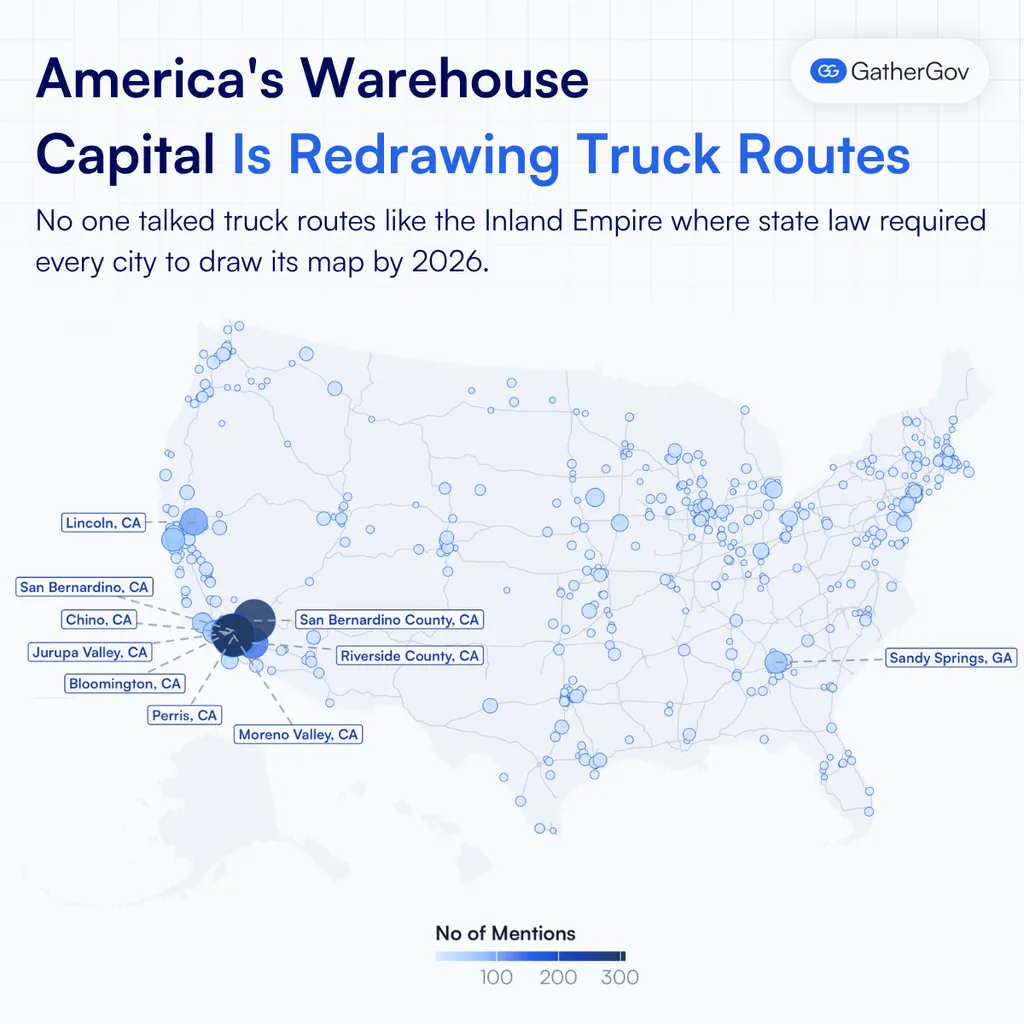
San Bernardino County logged 291 mentions across 16 meetings, the most in the dataset, after adopting truck routes for unincorporated areas including Bloomington, where warehouse projects were already contentious. Moreno Valley logged 179 mentions across 41 meetings, the most meetings of any city, and its Planning Commission reviewed a major August 2026 revision that strips most residential streets from the route map and concentrates official routes on the industrial southwest side, with staff saying the change should take effect within four months. Perris tied its truck routes directly to revenue, revisiting a local measure that raises roughly $4 million a year for road repair along truck corridors. Jurupa Valley adopted a mobility element in August 2026 that “tiers in all the truck routes” and aligns the city with regional long-range plans.
Beyond the Inland Empire
Palm Desert, outside the mandated concentration region, told its council in December 2025 that its truck route changes “relate to the AB 98 legislation,” an early sign that the 2028 statewide deadline is already pulling other California cities into compliance work. Outside California, truck route activity looks different: West Chester, Pennsylvania rewrote its ordinance around PennDOT routes in August 2026, flipping from a banned-streets list to an allowed-routes list, while Johnstown, Colorado amended its municipal code truck route section in April 2026. In New York City, Brooklyn Community Board 10 unanimously opposed an expansion of truck routes on Third Avenue, a mixed residential-commercial corridor, a reminder that route fights aren’t limited to suburban logistics markets.
Why It Matters
San Bernardino County’s August 20, 2026 planning commission hearing showed what warehouse opposition looks like after AB 98: commenters argued the county’s own environmental review admitted air quality impacts near schools, and one speaker noted a developer had already agreed to modify a project to reduce truck route impacts, underscoring that routing is now a live negotiating point in entitlements. Cities are also starting to treat truck route maintenance as a cost to pass through: Port Hueneme staff estimated $98.9 million over 26 years to maintain just 5.6 miles of truck route pavement, a scale of cost that is pushing more jurisdictions toward fee structures aimed at industrial users. Buyers and developers of Inland Empire industrial land should check whether a site’s current truck route access still matches the map, GatherGov’s data shows several of those maps have changed in the past twelve months.
What’s Next
Expect route map revisions to keep moving through the rest of California’s Inland Empire over the next few months, with Moreno Valley’s residential-to-industrial reallocation model likely to spread to neighboring cities such as Chino, Ontario, Fontana, and Riverside. The bigger horizon is the 2028 statewide compliance deadline (2030 for smaller jurisdictions under SB 415 cleanup legislation), which should pull cities like Lincoln, National City, Alameda, and Oakland into the same routing and entitlement conversation over the next two years. Any California city with active or planned logistics development should be expected to revisit its truck route map well before then.