



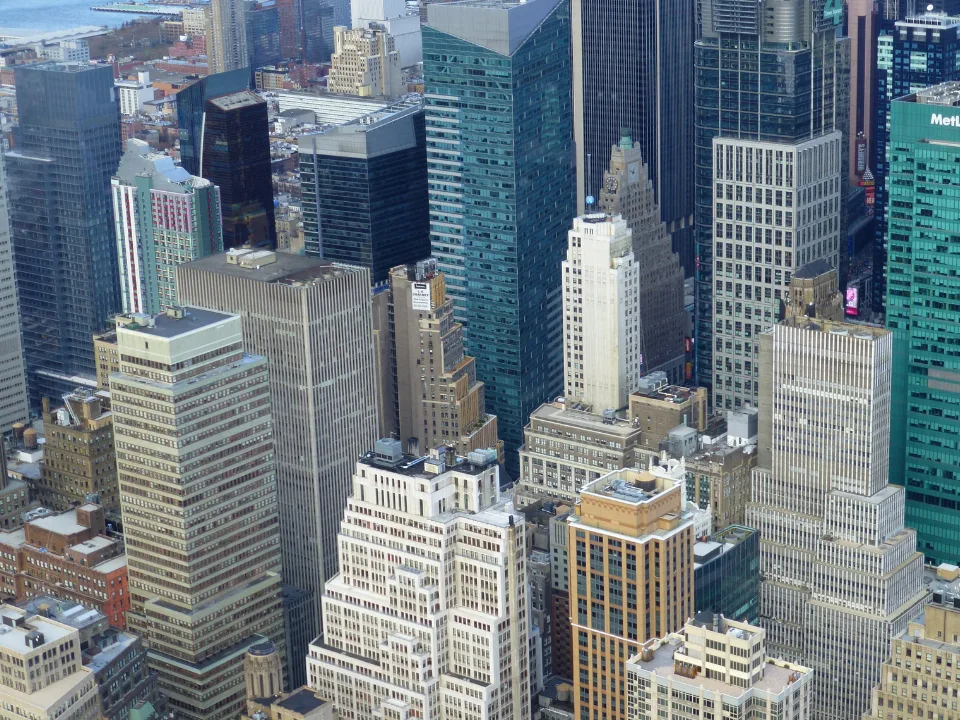
- Manhattan office rents rose 3% in H1 2026, while prime space commanded a 10% to 15% premium.
- Large-block availability is tightening, with future large-tenant requirements more than 30% above the 2018-2019 average and vacancy now expected to fall 2 to 2.2 percentage points this year.
- CBRE expects overall Manhattan asking rents to rise 5% to 6% by year-end, giving owners of well-located, amenity-rich buildings greater pricing power.
Manhattan office rents are climbing as tenant demand outpaces supply, with CBRE expecting asking rents to rise 5% to 6% by year-end 2026.
Manhattan office demand is accelerating, pushing rents higher and forcing tenants into earlier lease decisions as the supply of large, high-quality blocks shrinks. August 2026 U.S. Real Estate Market Outlook Midyear Review says the trend is broadening beyond traditional Midtown strongholds and beginning to pull more activity into secondary locations.
Get Smarter About What Matters in New York
Subscribe to our free newsletter covering the biggest commercial real estate stories across the five boroughs — delivered in just 5 minutes.
The office rebound gains momentum:
Manhattan’s office recovery is increasingly being defined by a shortage of quality inventory rather than a lack of tenant interest. Future large-tenant requirements are more than 30% above the 2018-2019 average, according to August 2026 report, with finance, law and technology firms leading demand. That imbalance is giving landlords of well-located, amenity-rich buildings more leverage as tenants compete for fewer large blocks.
The details:
Average Manhattan office rents rose 3% from 2025 during the first half of 2026, while prime space commanded a 10% to 15% premium. The brokerage expects rent growth to continue through the second half, with overall Manhattan asking rents projected to increase 5% to 6% for the full year.
The supply squeeze is particularly acute for blocks of 100,000 sq. ft. or more. CBRE has revised its earlier forecast for Manhattan’s overall vacancy decline, now expecting a 2- to 2.2-percentage-point drop in 2026. New development commitments from American Express at Two World Trade Center, Simpson Thacher at 570 Fifth Avenue and McDermott Will at 343 Madison Avenue also point to continued tenant appetite for high-end, newly built space.
Tenants are responding with more creative deal structures, including split-floor arrangements, phased relocations and mid-sized expansion deals. Renewal activity is also starting earlier, suggesting occupiers expect availability to become even tighter during the second half of the year.
AI adds another demand engine:
Technology demand is helping reinforce Midtown South, where AI-related companies accounted for more than half of tech leasing in Q1 2026. That activity is expanding the pool of tenants competing for quality space even as Midtown remains the primary destination for major occupiers.
The result is a more pronounced divide between high-quality and commodity buildings. Well-maintained properties with stable ownership can still attract price-sensitive tenants, but distressed assets remain largely disconnected from the broader recovery. CBRE expects that bifurcation to deepen as demand spills from the tightest submarkets into peripheral Midtown, transit-oriented Midtown South and Downtown West.
Retail is feeling the same supply squeeze:
The same scarcity dynamic is emerging in Manhattan retail. Apparel and food-and-beverage tenants leased nearly 650,000 sq. ft. during H1 2026, while availability in prime corridors such as SoHo and Madison Avenue moved toward multi-year lows.
Spillover demand is beginning to lift next-tier neighborhoods, including the Meatpacking District and Williamsburg. In SoHo and Madison Avenue, the spread between asking and taking rents has recovered to 85% to 90%, while SoHo asking rents have reached record levels, reflecting continued demand from luxury brands.
Why it matters:
Manhattan’s recovery is becoming increasingly selective. Tenants can still find value in commodity office space, but the bargaining power they once enjoyed in prime buildings is fading as landlords gain pricing leverage and concessions become harder to secure.
For owners, the message is equally clear: quality is becoming a stronger source of pricing power. Owners with flexible configurations, strong amenities and the ability to accommodate phased or multi-floor requirements are best positioned to capture growing tenants. Meanwhile, underperforming properties face growing pressure to renovate or reposition if they want to participate in the recovery.
The improving leasing picture is also drawing more capital back toward Manhattan office. Office investment volume has returned to 2021-2022 levels, although it remains well below peak-cycle activity. The buyer pool has broadened to include high-net-worth investors, private equity, REITs and institutional capital, marking the broadest participation in several years.
What’s next:
The second half of 2026 will test whether Manhattan’s leasing recovery can keep outrunning its shrinking supply base. CBRE expects financing to remain available through H2 2026, with the 10-year Treasury rate stabilizing around 4.2% to 4.4%, providing more visibility for underwriting even as higher rates continue to limit capital flows.
For tenants, the implication is to start lease searches earlier and broaden the menu of configurations and neighborhoods. For owners and investors, the opportunity is increasingly concentrated in assets that can capture spillover demand as prime inventory disappears. With little new retail development and limited ground-up office construction expected to add meaningful supply, the scarcity story could extend into 2027.