




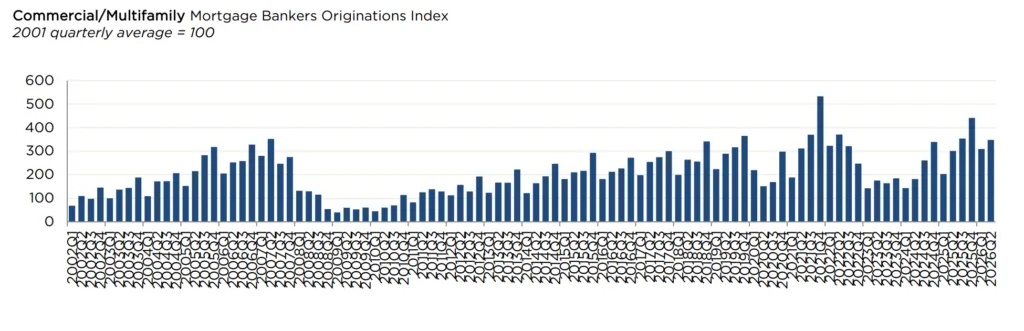
- Commercial and multifamily mortgage originations rose 16% year-over-year in Q2 2026, according to the MBA.
- Office and retail assets saw the biggest growth, with CMBS and depository lenders driving surges in origination volume.
- The rebound signals sustained improvement in CRE lending, but financing remains uneven across sectors and capital sources.
Capital Markets Unlock Growth
Commercial and multifamily lending accelerated in Q2 2026, marking the second consecutive quarter of recovery, according to the Mortgage Bankers Association. National originations grew 16% compared with Q2 2025. They also increased 12% from the previous quarter. Improved capital flows and stronger transaction pipelines drove the gains. Renewed risk appetite among institutional lenders also supported lending activity.
The office sector recorded an especially notable increase, challenging the narrative of persistent market distress. Meanwhile, CMBS lenders and depository institutions posted large gains and helped lead the broader recovery. Their increased activity reflects growing lender confidence as asset values stabilize and transaction markets regain momentum.
Get Smarter about what matters in CRE
Stay ahead of trends in commercial real estate with CRE Daily – the free newsletter delivering everything you need to start your day in just 5-minutes
Source: Mortgage Bankers Association
The Details
The MBA’s quarterly survey shows significant performance differences across property and lender types. Retail loan originations soared 61% year-over-year, while office originations jumped 47%. Hotels posted a 19% increase, while multifamily and industrial gained 8% and 6%, respectively. In contrast, health care property loan volume fell 19% compared with Q2 2025.
Lender contributions also varied considerably. CMBS loan originations rose 68% year-over-year, while depository lending increased 61%. Investor-driven lenders recorded an 18% increase. However, government-sponsored enterprise volumes fell 17%, while life insurer originations declined 27% from Q2 2025. Quarter-over-quarter, industrial lending surged 38%, while office increased 23% and multifamily climbed 15%. Sharp declines in hotel and health care lending partially offset those gains.
Lender and Sector Divergence Widens
The divide between property types and capital sources continued to widen during Q2 2026. Office and retail lending rebounded strongly after years of retrenchment. Office originations increased 47% year-over-year as lenders targeted discounted acquisitions, repositionings, and other potential opportunities. Retail’s 61% surge also reflects selective optimism around centers with strong fundamentals and resilient tenant demand. The improvement builds on earlier signs of stabilizing debt originations across the CRE market.
By contrast, the 19% decline in health care property originations highlights continuing volatility across the sector. Operators continue adjusting to changes in the post-pandemic operating environment. On the capital side, traditional banks and CMBS conduits significantly increased activity. Meanwhile, GSEs and life insurers pulled back. These trends reflect lingering uncertainty and growing demand for diversified capital stack solutions as interest rates stabilize.
Why It Matters
The commercial and multifamily lending rebound could mark an inflection point following significant CRE market dislocation during 2024 and 2025. The 16% annual gain and 12% quarterly increase show that capital is returning to the market. Greater liquidity can support transaction volume, asset repricing, refinancing activity, and stalled project restarts.
MBA Associate VP Reggie Booker attributed higher origination volumes to improving capital markets and stronger transaction activity. Momentum also reached historically challenged segments, particularly office properties and CMBS lending. However, the recovery remains uneven. Office’s 47% increase suggests select lenders increasingly see opportunities within previously distressed sectors. Meanwhile, health care originations fell 19%, and GSE lending declined 17% year-over-year.
Booker said the overall lending increase signals continued improvement despite uneven activity across the CRE finance market. The data shows liquidity returning, but lenders continue applying selective underwriting standards. Risk-adjusted opportunities increasingly attract capital toward value-add acquisitions and repositioning strategies rather than broad market expansion.
What’s Next
During the second half of 2026, industry observers will watch whether lending momentum continues as monetary policy and asset pricing evolve. Strong growth among CMBS lenders and banks could signal broader risk acceptance if credit markets continue improving. However, sector volatility will continue shaping origination strategies. Hotels and health care properties remain especially vulnerable after posting significant quarterly and annual swings.
Future MBA surveys should reveal whether Q2 growth marks a sustained lending cycle or a temporary rebound. Capital sources may continue rebalancing as lenders reassess risk, pricing, and property-level fundamentals. Sponsors and lenders will likely maintain selective strategies as economic visibility improves. Greater clarity around rates and CRE fundamentals could determine whether the recovery broadens through year-end.