




- About $65B in CMBS loans will mature by the end of 2026, with many borrowers facing limited extension options per Bisnow.
- Lenders and owners are shifting from rolling extensions to forced resolutions as higher debt costs upend refinancing math, especially for office.
- Increased special servicing and delinquency rates signal the maturity wave is accelerating distress and forcing valuations to reset.
Debt Reckoning Accelerates for CMBS Borrowers
After several years of rate hikes and ‘extend and pretend’ strategies, commercial real estate is hitting a new phase of day-of-reckoning. Bisnow reports that roughly $65B in CMBS loans will mature by year-end 2026, with $37B representing hard maturities offering no more extensions. Borrowers who financed assets during the pre-2022 low-rate era are now colliding with higher market rates and tighter loan underwriting standards. In August alone, Trepp is tracking 130 maturities totaling $5.5B—including five nonperforming loans, all on office properties.
This spike is notable as owners and lenders begin to move away from continuous refinancing in favor of more final resolutions—either bringing in new equity, restructuring, or handing over the keys. Distress rates are creeping higher, highlighting a market where access to additional capital is sorting winners from distressed sellers, especially in sectors like office and multifamily where valuation resets have been deepest.
Get Smarter about what matters in CRE
Stay ahead of trends in commercial real estate with CRE Daily – the free newsletter delivering everything you need to start your day in just 5-minutes
The End of ‘Extend and Pretend’
‘Extend and pretend’ has hit a wall as lending costs rise and property income struggles to keep pace. Special servicing has also increased as troubled retail and office loans place greater pressure on the CMBS market. According to Trepp’s July analysis, over half of maturing properties will need new borrower equity to refinance. Interest-only loans on office buildings show the largest gaps. Capital for top-tier assets remains available, but borrowers without the ability to write larger equity checks are increasingly out of options—a shift evident in the uptick of loans sent to special servicing.
The Details
The year-end pipeline is stark: $65B in CMBS maturities, with 130 loans totaling $5.5B hitting in August alone. Trepp reports that CMBS distress rose 51 basis points from June to July, reaching 7.86%—breaking a year-long flat trend.
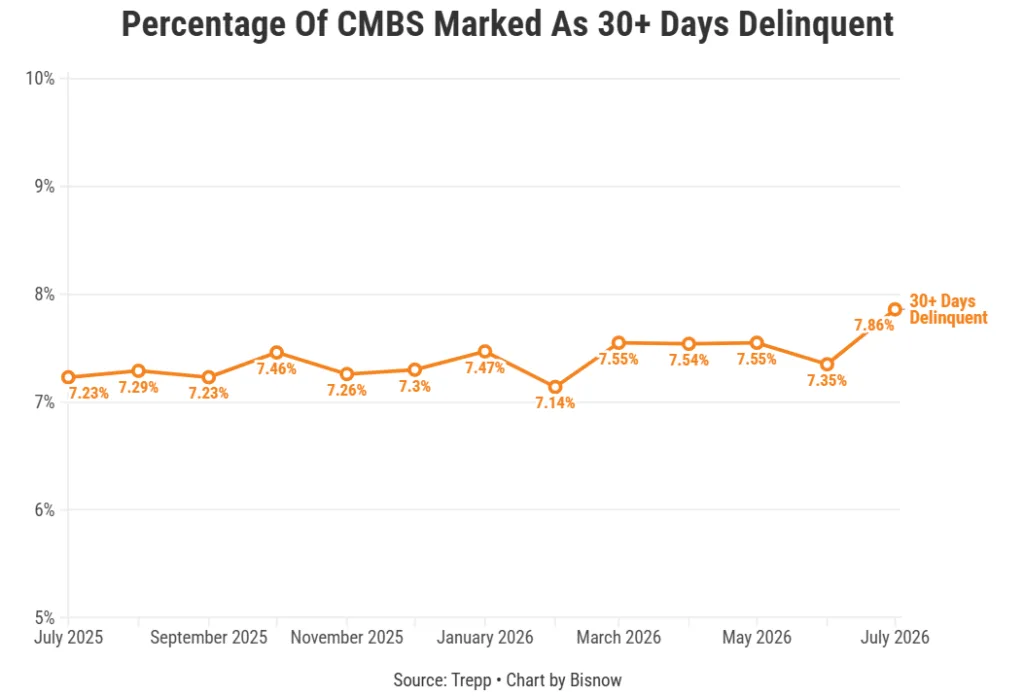
Seriously delinquent loans, including those 60 days past due or in foreclosure, climbed to 7.6%. Office distress is more acute, with an 11.91% rate, and all five nonperforming August maturities are office properties carrying $1.8B in debt. Notable recent deals show both ends of the spectrum: Soloviev Group and SL Green executed large Manhattan CMBS refis with significant cash-out, while Rithm Capital had to add $73M of equity to make a Midtown deal pencil. By contrast, a recent San Francisco office sale left bondholders with a major principal loss—recovering just $101M on a $240M investment.
Debt Maturities Add Pressure
Shifting bond market conditions are driving volatility across new originations. The rising 10-year Treasury—pushed upward by US macro risks including inflation and geopolitical tensions—directly reduces available loan proceeds, even when property fundamentals hold.
Trepp’s Andy Boettcher notes that with rate relief unlikely, buyers and sellers must close the valuation gap: either by pricing assets on actual cash flows or injecting fresh capital. Leasing and investment sales volumes are up year-over-year in nearly all CRE sectors, as reported by major brokerages in July earnings calls, but rising debt service is dragging performing assets into distress when maturities hit—particularly for office and multifamily operators who have resisted price corrections since 2022.
Why It Matters
The flood of upcoming CMBS maturities is forcing a broad price discovery moment, ending an era where borrowers could count on endless extensions or hope for a return to lower rates. According to Trepp, CMBS distress climbed meaningfully in July, with office leading the way at nearly 12%—more than four percentage points above the overall average. Office operators, in particular, now face sharply restricted refinancing options as lenders grow wary of another extension round.
Owner willingness to add equity—and accept post-pandemic value resets—is emerging as the dividing line between those who can survive the maturity wave and those who will lose assets, sometimes at significant losses. Recent headlines from New York and San Francisco show both: some sponsors can refinance, even pull cash out, if occupancy and income are strong; others must take a loss or write big checks to make deals work. Fierce deal competition for best-in-class assets continues, but older and challenged stock, especially in office, is at risk of being sold for a fraction of its previous value. Brokerages like JLL note abundant capital and liquid debt markets in Q2 2026, but warn that required pricing adjustments are a reality for most maturing loans.
This maturity wall matters for the broader CRE market because it will set a new baseline for asset pricing, potentially accelerate special servicing activity, and define which owners remain viable as lenders enforce new rules of engagement. Distress rates and foreclosures could rise in the coming quarters, bringing long-awaited clarity to property values—but that clarity may come via more forced sales and equity wipes.
What’s Next
The remainder of 2026 will test CRE’s ability to adapt as the CMBS sector confronts its $65B maturity wall. Owners must bring fresh capital or accept price corrections, as lenders appear less willing to delay resolutions. The resolution trend is expected to continue, especially for office, where distress is most acute and extension fatigue is evident. More assets are likely to hit the market, creating opportunities for cash-rich buyers at new basis levels. If interest rates remain elevated, ongoing refinancing challenges could ripple into 2027, making this a pivotal year for pricing resets and asset repositioning across all major sectors.