



- US industrial markets saw e-commerce’s retail sales share hit 16.9% in Q1 2026, surpassing the pandemic high, according to CompStak’s new report.
- Chinese import volumes into the US dropped 49.6% year-over-year in January 2026, amplifying a broader contraction in goods imports.
- Gateway industrial markets diverged, as West Coast rents posted steep corrections, while Chicago and Dallas remain near cycle highs, signaling shifting tenant demand.
Tariffs, Supply Chains, and E-Commerce Redefine Demand
The US industrial market continued to absorb tariff shocks and post-pandemic spending shifts in early 2026, CompStak reports. Total goods imports peaked at $342.3B in March 2025. They then posted three straight double-digit year-over-year declines outside the COVID period. Chinese imports fell 49.6% in January 2026. However, e-commerce stayed strong. Its share of US retail sales reached 16.9% in Q1 2026, topping the pandemic record of 16.3%.
These trends are reshaping occupier demand, inventory strategies, and lease pricing. Supply chain pressure reached its highest level since July 2022 this spring, based on the New York Fed’s index. Warehouse utilization remained high. Meanwhile, retail inventories-to-sales ratios fell 5.3% from their August 2024 peak, signaling lean inventories before another restocking cycle.
Get Smarter about what matters in CRE
Stay ahead of trends in commercial real estate with CRE Daily – the free newsletter delivering everything you need to start your day in just 5-minutes
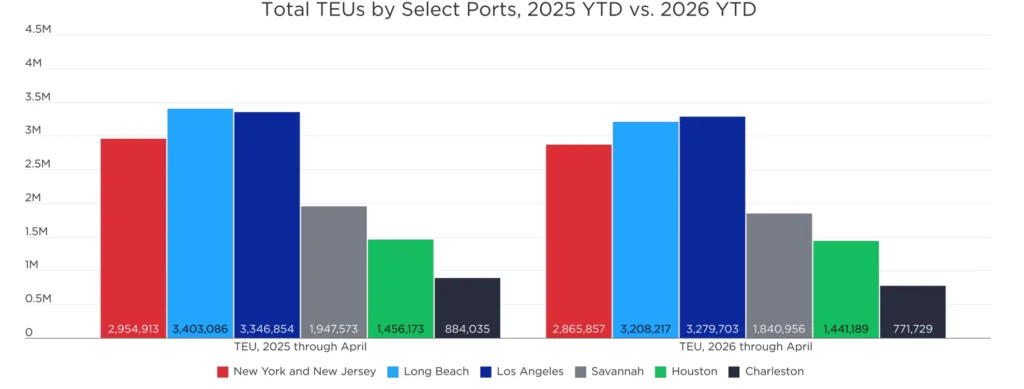
Source: Ports of Long Beach, Los Angeles, Savannah, Houston, Charleston, and the Port of New York and New Jersey. Measures volumes through April 2025 vs. April 2026.
The Details
CompStak’s Columbia Rent Index shows national industrial asking rents plateaued during the past eight quarters. They stayed between 12.03 and 12.61, roughly 70% above pre-pandemic levels. The West Coast saw the largest corrections. Inland Empire rents dropped 31.1% from their peak, while Los Angeles declined 25.7% over 12 quarters.
Meanwhile, Chicago reached new highs. Dallas-Fort Worth remained only 0.4% below its peak after a modest five-quarter correction. New Jersey and Philadelphia offer the strongest near-term rent growth potential. New lease starting rents exceed in-place rents for expiring space by 35% to 42%.
Renewal rent increases for leases above 500K SF rebounded to 83.7% in Q1 2026. They had fallen to 49.2% in Q2 2025. Smaller leases posted lower renewal increases. Non-bulk free rent reached a cycle high at 4.5% of lease terms. This suggests concessions remain elevated but may have peaked for bulk deals.
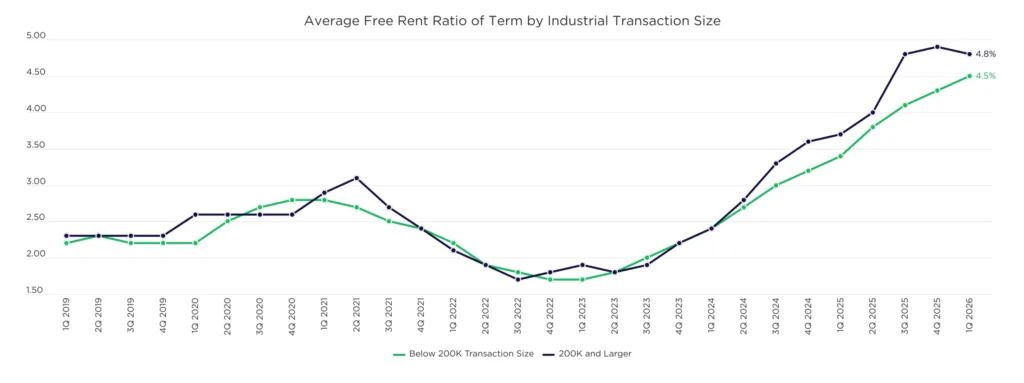
Source: CompStak. Measures share of lease term given to a free rent period.
Post-COVID Deceleration, Regional Divergence
After rapid expansion between 2020 and 2023, construction activity slowed. Logistics construction spending peaked at $155.4B in September 2023. It then declined 21% through April 2026. Manufacturing investment followed a similar trend, dropping 22.7% from its August 2024 peak. Even so, both remain above pre-pandemic levels. Lease terms also normalized. Bulk leases averaged 80.6 months, while non-bulk leases averaged 59.7 months.
Leasing demand split into two clear segments during 2026. Mega leases above 750K SF and small-bay leases below 200K SF captured record shares of deal value. Mid-size deals fell to a dataset low of 29.7%. This bifurcation also reflects broader tariff-driven shifts in industrial leasing activity across major US logistics markets. IOS properties showed the widest rent spread, with market rents 29.8% above in-place levels. New Jersey, Philadelphia, Dallas, and Atlanta offer the strongest repricing potential. Greater Los Angeles faces downward renewal pressure.
Why It Matters
Industrial investors still benefit from strong long-term fundamentals, but new risks are emerging. Rising e-commerce demand supports fulfillment and last-mile facilities. These assets remain especially attractive in dense urban markets. However, US-China imports fell 49.6% in January and remained 21.9% lower through April. That decline increases uncertainty for port markets and logistics operators.
Regional performance continues to diverge. New Jersey and Philadelphia offer strong repricing opportunities because starting rents exceed in-place rents by 35% to 42%. In contrast, Los Angeles-area starting rents now sit slightly below in-place levels. This gap could widen further if economic conditions weaken.
Labor markets have stabilized but stopped expanding. Manufacturing, transportation, and warehousing employment remain below previous peaks and flat year over year. Construction activity continues to cool. Still, spending remains well above pre-pandemic levels. Another restocking cycle could quickly tighten available industrial space if demand accelerates.
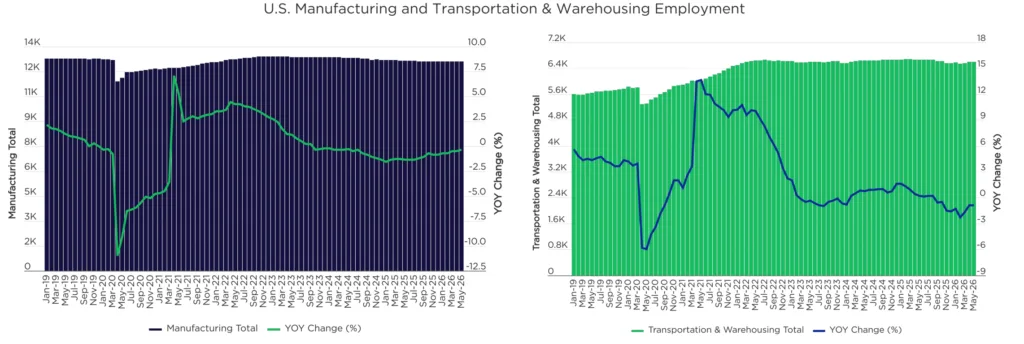
Source: US Bureau of Labor Statistics, US Employment, Hours, and Earnings – National, All Employees, In Thousands, seasonally adjusted.
What’s Next
During the second half of 2026, investors and occupiers will watch for further stabilization. Bulk properties deserve close attention because effective rents turned positive year over year. Demand for larger facilities will influence future development plans and lease renewal strategies. East Coast owners may benefit from strong repricing opportunities. Meanwhile, West Coast and port market landlords face greater uncertainty if imports remain weak.
Looking toward 2027, tariff policy, consumer spending, and supply chain normalization will shape industrial rent growth, investment activity, and construction. Regional, data-driven asset management will become increasingly important. Investors who identify local advantages should outperform owners of structurally weaker assets.