





Robora Overview
Commercial real estate owners often manage dozens—or even hundreds—of operating accounts across multiple banks. While those accounts are necessary for entity-level accounting, lender requirements, and liability protection, they create operational challenges. Treasury teams frequently log into multiple banking portals, manually monitor balances, and leave idle cash earning little to no interest.
Robora was built to solve that problem.
Rather than requiring companies to replace their existing banking relationships, Robora connects to current bank accounts and automates treasury management. The platform centralizes visibility across multiple financial institutions, automates cash sweeps into higher-yield FDIC-insured accounts, and provides a single dashboard for monitoring liquidity.
Founded by former banking executives, Robora helps middle-market commercial real estate firms maximize returns on idle cash while simplifying treasury operations. Finance teams can monitor balances, transaction activity, and cash flow across every connected entity without disrupting existing banking relationships.
For sponsors managing multiple LLCs, properties, and banking partners, Robora offers a practical way to improve cash returns while reducing the administrative burden of treasury management.
Disclosure: Robora is a financial technology company, not a bank. Banking services are provided by OMB Bank, Member FDIC. FDIC insurance applies to eligible deposits held at insured depository institutions, subject to applicable limits, ownership categories, and program terms. Deposit placement through the IntraFi network is subject to eligibility requirements.
Our Take On Robora

Best for commercial real estate owners and operators who manage multiple bank accounts and want to increase returns on idle cash without changing their existing banking relationships.
Robora is a treasury management platform that helps commercial real estate firms optimize idle cash, automate cash sweeps, and centralize visibility across multiple bank accounts without changing their existing banking relationships.
 Pros
Pros- Connects to existing bank accounts without requiring companies to switch banks.
- Automatically sweeps excess cash into higher-yield FDIC-insured accounts.
- Centralizes balances and transaction history across multiple financial institutions.
- Purpose-built for CRE firms managing multiple entities and properties.
- Transparent pricing with no monthly platform fees.
- White-glove onboarding simplifies implementation.
 Cons
Cons- Requires a minimum initial deposit of $25,000.
- The highest APY is reserved for customers maintaining larger average balances.
- Focused primarily on treasury management rather than full-service banking.
Pros Explained
Connects to existing banking relationships: One of Robora’s biggest differentiators is that it doesn’t require companies to replace their existing banks. Instead, the platform securely connects to current operating accounts, allowing firms to continue using their preferred banking partners while improving cash management behind the scenes. This minimizes implementation friction, eliminating the need to update payment instructions, vendor information, lender relationships, or day-to-day operating workflows simply to earn a higher return on idle cash.
Automates treasury management: Robora automates cash management with customizable sweep rules that maintain minimum operating balances and transfer excess cash to higher-yield accounts. The platform also monitors accounts daily and automatically replenishes funds if balances fall below preset thresholds, helping firms maintain minimum balances and reducing the hours spent on manual treasury management.
Consolidates banking into a single dashboard: Robora consolidates accounts across multiple banks into a centralized dashboard where finance teams can monitor balances, transactions, interest earned, and cash optimization metrics in one place. By eliminating the need to log into multiple banking portals, the platform provides a more efficient way to manage treasury operations across an entire real estate portfolio.
Designed specifically for commercial real estate: While Robora can serve businesses across industries, its multi-entity structure is especially well-suited to the sector. The platform allows firms to manage separate property, LLC, fund, and operating accounts from a single dashboard while maintaining organizational separation and assigning role-based permissions to different team members.
White-glove implementation: Robora offers white-glove onboarding, with its team assisting customers through account setup, entity onboarding, bank synchronization, and implementation to reduce administrative work and accelerate deployment.
Cons Explained
$25,000 minimum opening balance: Robora requires a $25,000 minimum initial deposit, which may make the platform less accessible for smaller firms or newly established investment companies with limited operating cash.
Larger balances receive the greatest benefit: Companies maintaining average monthly balances of $250,000 or more qualify for Robora’s highest APY, meaning firms with smaller cash balances may see more modest returns despite still benefiting from the platform’s treasury automation and centralized cash management.
Not intended to replace your primary bank: Robora is designed to complement—not replace—existing banking relationships. Companies continue using their primary banks for day-to-day operations while leveraging Robora to optimize idle cash and centralize treasury management.
Key Features
Robora combines treasury automation, cash optimization, and banking visibility into a single platform designed specifically for businesses managing multiple operating accounts. Rather than replacing existing banking relationships, the platform enhances them by providing centralized oversight and automated cash management.
Automated Cash Sweeps
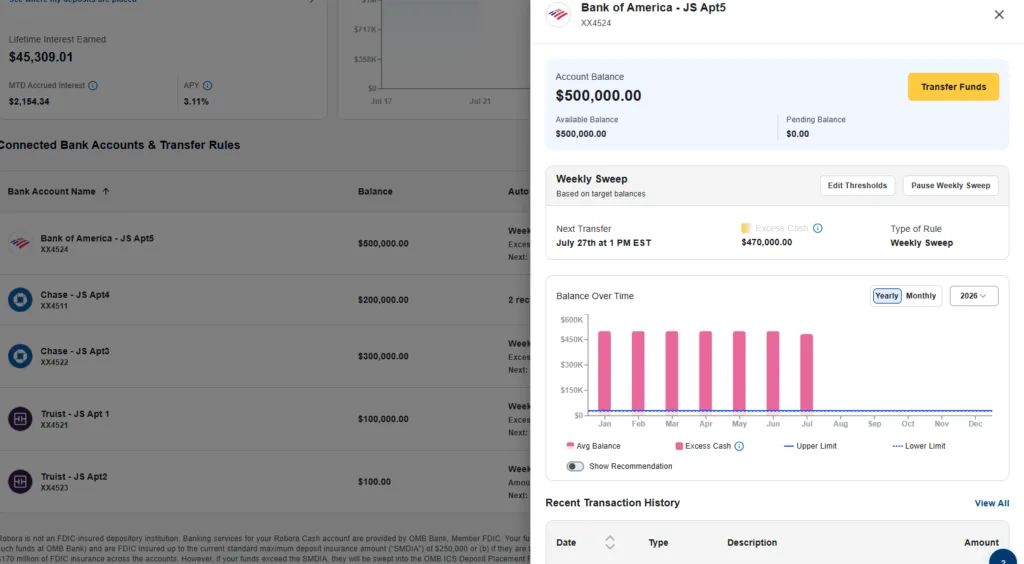
Robora’s core feature is its automated cash sweep engine, which continuously optimizes idle cash without disrupting daily banking operations.
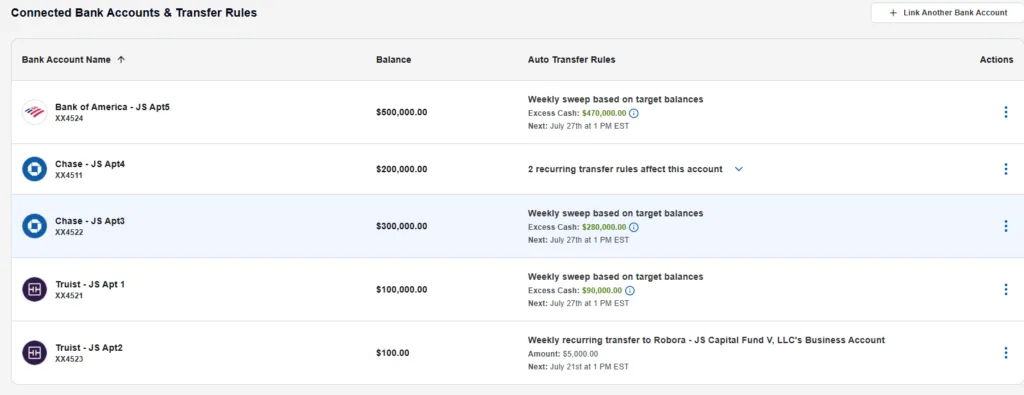
Users establish minimum and maximum operating balances for each connected bank account. At scheduled intervals, the platform evaluates each account and automatically transfers excess funds to a high-yield FDIC-insured account while ensuring sufficient liquidity remains for upcoming expenses.
If account balances unexpectedly fall below predefined thresholds due to unplanned withdrawals or vendor payments, Robora automatically transfers funds back into the operating account before balances become critically low. This proactive approach helps finance teams maintain liquidity while maximizing returns on excess cash.
Centralized Banking Dashboard
One of Robora’s most valuable features for commercial real estate firms is its centralized banking dashboard.
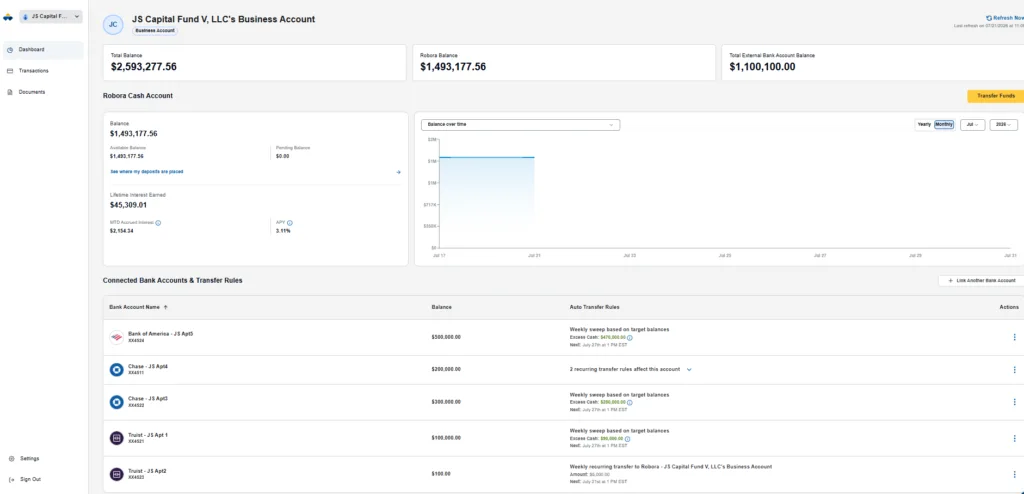
Rather than logging into multiple banking portals each day, users can monitor all connected accounts from a single interface. The dashboard displays current balances, optimized cash, month-to-date interest earned, transaction history, and cash allocation across portfolios.
For firms managing dozens—or hundreds—of bank accounts across multiple institutions, this significantly simplifies treasury oversight while improving visibility into available liquidity.
Multi-Entity Portfolio Management
Commercial real estate ownership structures are rarely simple. Sponsors often maintain separate bank accounts for each property, LLC, fund, or holding company.
Robora accommodates these structures by allowing organizations to group accounts according to their preferred hierarchy while maintaining separate ownership and accounting requirements.
Companies can choose whether certain accounts remain completely separate or whether cash from related entities can be managed collectively within a shared treasury structure. This flexibility makes the platform adaptable for syndications, funds, owner-operator portfolios, and institutional real estate firms alike.
Flexible User Permissions
Robora includes role-based permissions that allow organizations to control who can view or manage treasury operations.
Administrators can assign different access levels to executives, controllers, accountants, and asset managers. Some users may receive full administrative rights, while others may only be able to view balances and download reports, without the ability to initiate transfers or add bank accounts.
This permission structure allows companies to maintain strong internal controls while giving relevant stakeholders access to the information they need.
Expanded FDIC Insurance
Another differentiating feature is Robora’s use of its banking partner’s participation in the IntraFi banking network.
Rather than limiting deposit insurance to the standard FDIC threshold available at a single institution, qualifying deposits can be distributed across participating network banks, significantly increasing available FDIC coverage while remaining visible through a single account.
For commercial real estate firms that maintain large reserve balances or are awaiting capital deployment, this provides an additional layer of security without requiring multiple banking relationships.
Cash Analytics & Reporting
Beyond simply moving money, Robora provides treasury analytics that help finance teams understand how cash is being utilized.
Users can monitor interest earned, optimized balances, available liquidity, and historical transaction activity across all connected accounts. These reporting capabilities provide controllers and CFOs with a consolidated view of organizational cash while reducing manual reconciliation between banking portals.
Security
Robora is designed with a security-first architecture.
The platform never takes custody of customer funds. Instead, funds remain with Robora’s FDIC Member banking partner, while Robora serves as the technology layer that facilitates secure connectivity and treasury automation.
Bank connections use encrypted integrations and approved third-party connectivity providers. Where login authentication is required, credentials are transmitted through the applicable secure connection process rather than stored by Robora. Because transfers are limited between linked operating accounts and designated Robora accounts, the platform also introduces guardrails that reduce exposure to unauthorized third-party transfers.
Coming Soon
Robora’s model is to enhance its solutions to improve real estate and other cash and treasury management. Future product releases include:
- Operating Account: The company is weeks away from launching its full-service operating and checking account. This will enable 100% cash returns with lower fees than banks, saving many clients hundreds of thousands of dollars in bank treasury fees.
- Agentic Payments: Invoice matching, processing, and optimizing
- AI Forecasting: Instant and customizable forecasting for cash flow and payments
User Experience
Robora offers a clean, intuitive interface that prioritizes visibility rather than complexity. The dashboard is designed around treasury workflows, allowing finance teams to quickly understand where cash is located, how much is earning interest, and whether any accounts require attention.
Despite managing sophisticated treasury operations behind the scenes, daily use remains straightforward. Most users interact with dashboards, review automated activity, and adjust sweep rules as business needs evolve rather than performing repetitive manual transfers.
Organizations with complex legal structures will appreciate the ability to navigate between holding companies, funds, and individual property entities without switching platforms or logging into multiple banking portals.
Because implementation includes white-glove onboarding, new users can typically begin using the platform with minimal learning.
Customer Support
Robora emphasizes a consultative customer experience rather than a self-service software model.
Each implementation includes white-glove onboarding, during which the Robora team assists with entity setup, account configuration, banking integrations, and treasury strategy. Rather than leaving customers to configure complex banking relationships independently, Robora works directly with finance teams throughout the implementation process.
This personalized approach is particularly valuable for commercial real estate firms onboarding dozens of legal entities and multiple financial institutions simultaneously.
Support continues after implementation, with ongoing assistance available as organizations add properties, restructure portfolios, or adjust treasury strategies.
Pricing
Robora’s pricing model is refreshingly transparent.
There are no monthly platform fees, allowing companies to benefit from treasury automation without recurring software costs.
Current rates include:
- 3.11% APY for customers maintaining average monthly balances of $250,000 or greater
- 2.65% APY for average monthly balances below $250,000
- $25,000 minimum initial deposit
- No monthly account fees
- Unlimited transfers
- Free Standard ACH
- Free Same-Day ACH
- $25 outgoing wire transfers
Unlike many treasury products that rely on complex pricing schedules or hidden banking fees, Robora’s straightforward structure makes expected returns relatively easy to understand.
Pricing Disclosure: Rates and terms shown are current as of July 2026, are variable, and are subject to change. Additional eligibility requirements and account terms may apply.
Competitors
Flourish Cash
Flourish provides cash management and high-yield deposit solutions primarily for registered investment advisors and wealth managers serving high-net-worth clients. While both platforms focus on optimizing idle cash, Robora places much greater emphasis on treasury management for commercial real estate businesses with multiple operating entities and bank accounts.
Mercury
Mercury combines business banking with treasury services for startups and technology companies. It offers competitive yields and integrated banking products but is designed as a primary banking relationship. Robora instead complements existing banks, allowing businesses to improve treasury management without replacing established banking relationships.
Meow
Meow offers business treasury accounts with competitive yields and cash management tools. Unlike Robora, Meow increasingly encourages customers to consolidate broader banking services within its ecosystem. Robora’s approach remains focused on treasury optimization while allowing customers to maintain their existing banking infrastructure.
FAQs
Robora is a treasury management and cash optimization platform that helps commercial real estate firms automate cash sweeps, centralize banking visibility, and earn higher returns on idle operating cash while maintaining their existing banking relationships.
Robora is best suited for commercial real estate owners, developers, operators, and investment firms managing multiple entities, properties, and bank accounts. Organizations maintaining significant operating reserves will generally realize the greatest value.
No. Robora is designed to complement existing banking relationships rather than replace them. Businesses continue using their preferred banks for daily operations while Robora automates treasury management and cash optimization.
Customers maintaining average monthly balances of $250,000 or more currently earn 3.11% APY, while smaller balances earn 2.65% APY. Rates may change over time based on market conditions.
No. Robora does not currently charge monthly platform fees. Customers simply need a minimum opening deposit of $25,000.
Implementation includes white-glove onboarding, during which Robora assists with entity setup, bank connections, and account configuration. Timelines vary depending on the number of entities and financial institutions being onboarded.
How We Evaluated Robora
When evaluating Robora, we examined several factors, including:
- Product and service offerings: We evaluated the depth of Robora’s treasury management capabilities, cash optimization tools, and banking integrations, as well as how effectively the platform addresses the needs of commercial real estate operators.
- Pros and Cons: We compared Robora’s differentiators—including automated cash sweeps, centralized banking visibility, and transparent pricing—against potential limitations across different user types.
- Ease of use: We examined the platform’s user interface, onboarding process, dashboard design, and the ease with which finance teams can manage multiple entities and banking relationships.
- Customer support: We reviewed Robora’s implementation process, white-glove onboarding, and ongoing customer support resources.
- Pricing and transparency: We evaluated Robora’s interest rate structure, minimum balance requirements, banking fees, and overall pricing transparency.
Summary of Robora Review
Treasury management is rarely viewed as a competitive advantage in commercial real estate, yet idle cash can quietly represent one of a firm’s largest untapped opportunities. Robora addresses this challenge by helping companies automate cash management, improve liquidity visibility, and generate additional returns without disrupting established banking relationships.
Its centralized dashboard, automated sweep rules, multi-entity support, and transparent pricing make it particularly well-suited for commercial real estate owners managing numerous operating accounts across multiple banks. While firms with smaller cash balances may realize fewer financial benefits, organizations maintaining substantial operating reserves can potentially generate meaningful incremental income while reducing manual treasury work.
For finance teams seeking a modern treasury solution rather than another banking relationship, Robora delivers a thoughtful combination of automation, visibility, and operational simplicity.
Disclaimer
These recommendations are based on our direct experience with these companies and are suggested for their usefulness and effectiveness. We advise only purchasing products that you believe will assist in reaching your business objectives and investment goals. Nothing in this message should be regarded as investment advice, either on behalf of a particular security or regarding an overall investment strategy, a recommendation, an offer to sell, or a solicitation of or an offer to buy any security. Advice from a securities professional is strongly advised, and we recommend that you consult with a financial advisor, attorney, accountant, and any other professional who can help you understand and assess the risks associated with any real estate investment. For any questions or assistance, feel free to contact [email protected]. We’re here to help!