





- Economic and population growth in New York are heavily concentrated around New York City, while many regions face decline.
- High taxes and spending support major public services, but business and population outmigration create fiscal pressures for the state.
- Despite high education and income levels, persistent regional disparities and uneven job growth pose long-term policy challenges.
Growth Concentrates Around Key Corridors
New York remains an economic heavyweight, but prosperity increasingly concentrates in a handful of regions. The Citizens Budget Commission’s Competitive NYS tracker highlights sharp differences across the state.
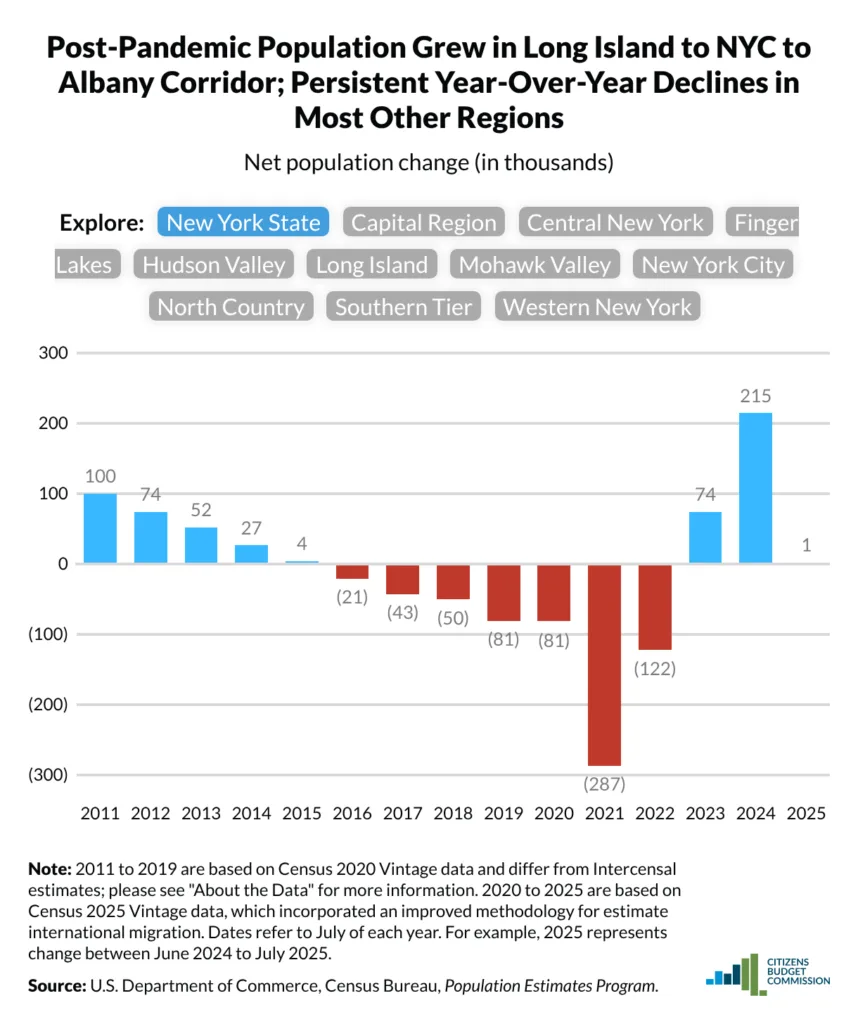
Growth and opportunity largely follow the Long Island-to-Albany corridor, while much of upstate continues shrinking. Since 2010, 22 New York counties have lost at least 5% of their populations.
Domestic outmigration continues driving this divide. New York has lost thousands of residents and billions in income to Connecticut and Florida. The state’s population remains roughly 200,000 below its 2019 peak, showing the challenge’s scale and persistence.
Get Smarter About What Matters in New York
Subscribe to our free newsletter covering the biggest commercial real estate stories across the five boroughs — delivered in just 5 minutes.
The Details
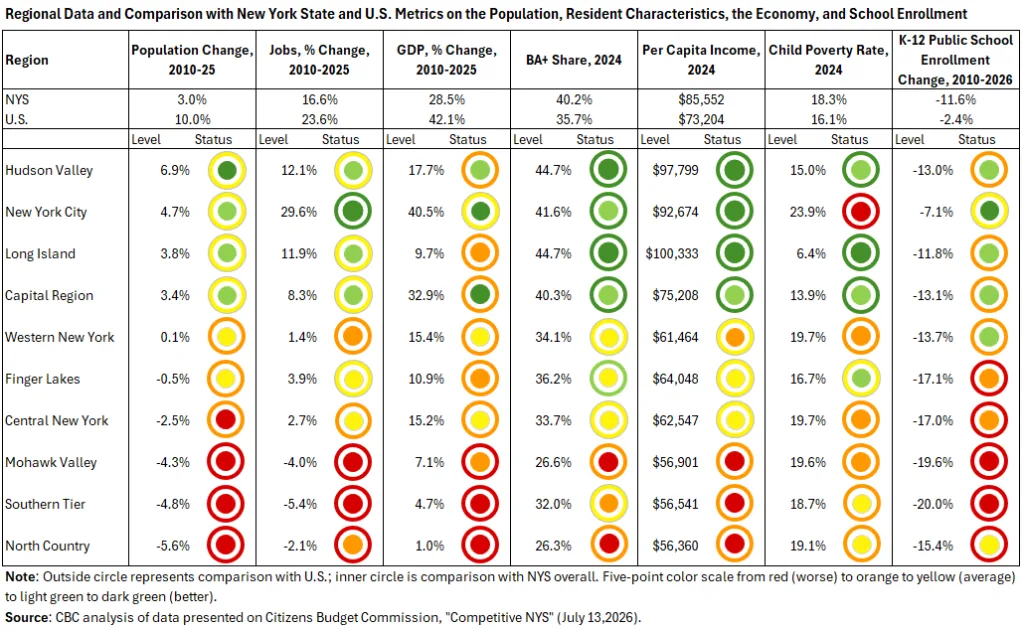
New York recorded only 3% population growth since 2010, compared with 10% nationwide. Most gains occurred around New York City, Long Island, the Hudson Valley, and the Capital Region.
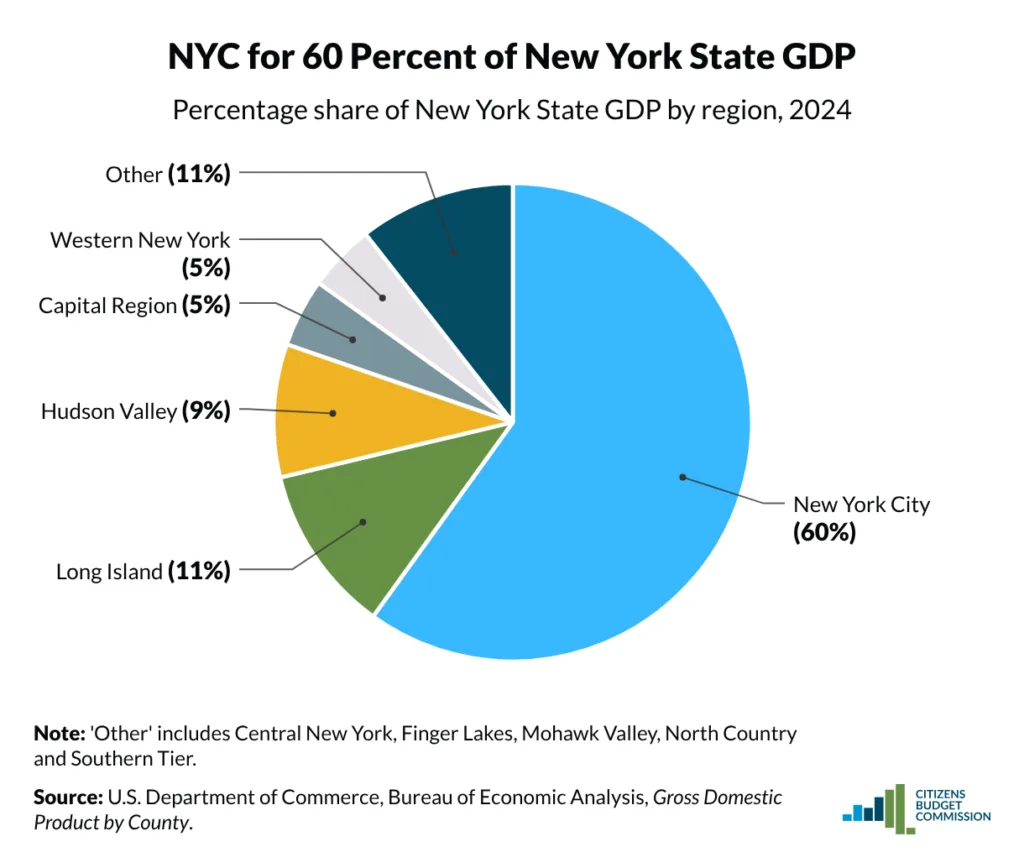
These areas now contain 79% of statewide employment and generate 85% of New York’s GDP. Meanwhile, Central and Western New York, the Mohawk Valley, North Country, and Southern Tier continue losing residents.
Natural population declines, where deaths exceed births, have also become common. High earners represent a particularly significant source of outmigration.
From 2019 through 2023, New York lost a net 53,404 residents to Fairfield County, Connecticut. Those departures represented $7.2B in adjusted gross income.
The state also lost more than $7.3B in income to Palm Beach County, Florida. International migration offsets losses in some areas. However, many upstate counties increasingly depend on newcomers to maintain stable labor forces.
Regional Disparities Deepen as Costs Rise
New York retains major advantages, including strong educational attainment, above-average incomes, and favorable health metrics. More than 40% of adults hold bachelor’s degrees.
However, these advantages remain strongest around the state’s largest urban clusters. New York also faces growing competition from Dallas and Miami for financial firms, jobs, and investment. Roughly 18% of New Yorkers are now 65 or older. This aging population creates additional demographic pressure, particularly across upstate communities.
Fiscal pressures add another challenge. New York collected $12,495 in tax revenue per resident in 2023, according to CBC. That figure stood 78% above the national average and ranked highest among US states.
Top earners remain critical to this fiscal model. However, New York’s share of US million-dollar filers dropped significantly. It fell from 12.7% in 2010 to 8.7% by 2022, narrowing the state’s tax base.
Meanwhile, public services remain expensive. Per-pupil K-12 education spending approached $32,000 in 2024, more than 80% above the US average.
Yet academic performance has struggled to match that spending. New York trails Massachusetts and New Jersey despite spending considerably more. Public school enrollment has also fallen, with 323,000 fewer students since 2010.
Why It Matters
New York’s widening regional divide creates major implications for CRE and the broader business community. Nearly two-thirds of statewide real GDP growth came from New York City between 2001 and 2024.
As a result, development, business lending, and infrastructure investment increasingly concentrate where populations and payrolls grow. Outside these areas, demographic pressures weaken investment fundamentals.
Shrinking populations, aging communities, and limited employment gains reduce demand for new development. The issue extends beyond migration into broader economic concentration.
The four most dynamic regions now dominate both job creation and economic output. This concentration could deepen regional differences in property demand and investment activity.
Fiscal risks also remain significant. New York expects its state reserve to reach $15.1B for FY2027. However, CBC estimates a deep recession could require reserves between $35B and $50B.
Continued departures among high-earning taxpayers add pressure. New York’s high-tax, high-spending model increasingly depends on a narrower tax base.
CBC argues that maintaining strong public services will require broader economic growth. Otherwise, policymakers could face difficult decisions involving costs, taxes, and competitiveness.
What’s Next
Policy and CRE leaders will closely watch New York’s response to its regional and demographic divides. CBC highlights affordability and housing production among key priorities.
Other priorities include childcare access, tax modernization, regulatory reform, and more effective economic development spending. These policies could influence where businesses, residents, and capital move.
The fiscal 2027–2028 policy cycle will test the state’s ability to retain residents and attract newcomers. Leaders will also face pressure to spread job growth beyond existing economic centers.
Meanwhile, development pipelines will likely remain strongest around New York City and other growing regions. Upstate markets may require new investment models or public-private partnerships.
For developers and investors, the central question remains where New York’s next sustainable growth cycle will emerge.