






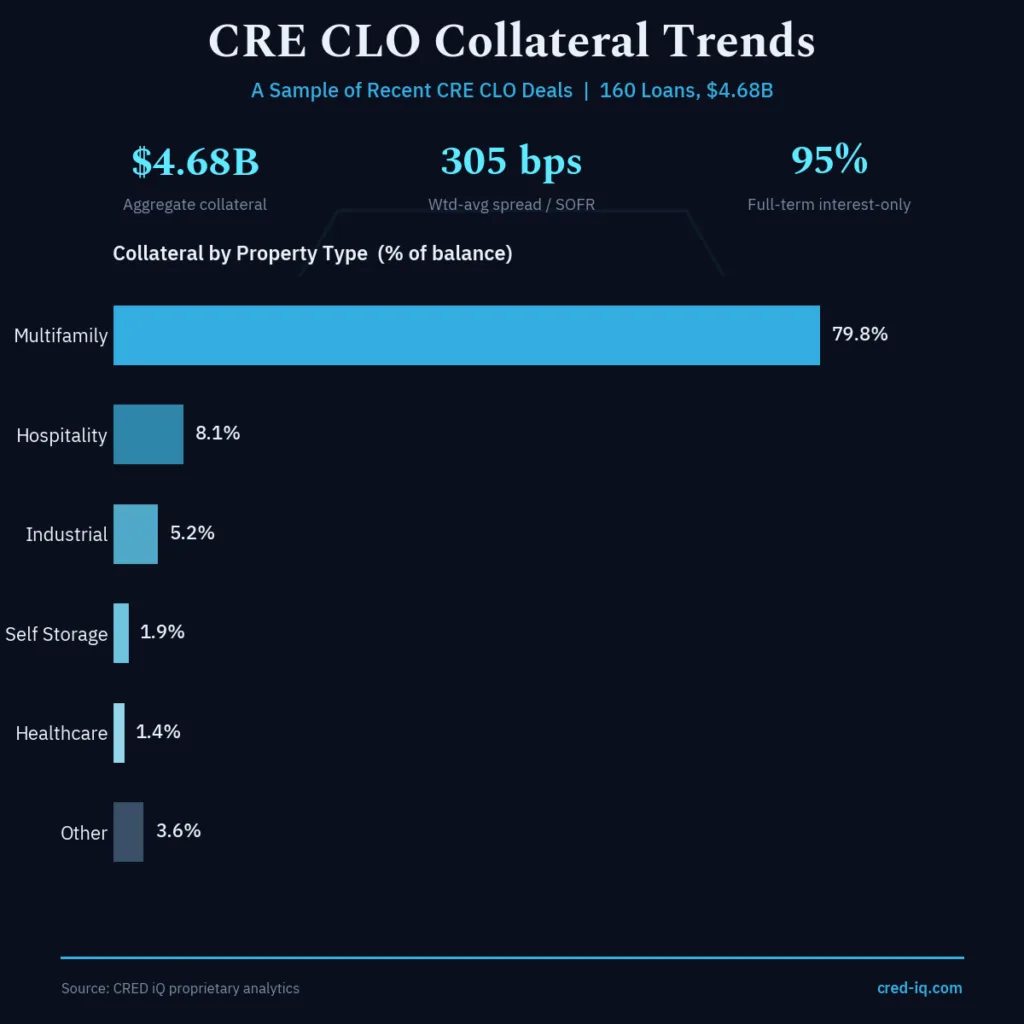
- Multifamily loans make up nearly 80% of recent CRE CLO collateral by balance, per CRED iQ.
- Issuers overwhelmingly favor full-term interest-only structures, with 95% of collateral using IO terms.
- Concentration in multifamily and IO terms increases refi risk at maturity as rates remain elevated.
CRE CLOs Double Down on Multifamily
Commercial real estate CLO issuers are sticking with familiar assets in a volatile market. The Commercial Observer reports that according to CRED iQ, multifamily assets back nearly 80% of collateral in a $4.68B sample of recent deals.
Other asset classes trail far behind. Hospitality represents 8.1%, while industrial accounts for 5.2%. Office, retail, and healthcare each represent less than 1%.
This allocation highlights a deliberate shift toward sectors that lenders view as safer bets. Interest rates remain elevated, while several other property types continue losing favor with investors.
Get Smarter about what matters in CRE
Stay ahead of trends in commercial real estate with CRE Daily – the free newsletter delivering everything you need to start your day in just 5-minutes
The Details
The CRED iQ analysis covered 160 loans originated for recent CRE CLOs. The findings revealed several clear structural similarities across the loan pools.
Almost 95% of collateral carries full-term interest-only (IO) terms. These structures give borrowers greater flexibility and stronger early cash flow. Sponsors can use that flexibility while executing business plans on transitional or value-add properties.
Coupons use floating rates, with an average spread of 303 basis points over SOFR. The loans carry an average all-in coupon of 6.68%.
Additionally, these CLOs include $244M in future funding commitments. That capital will likely support renovation, lease-up, and other property improvement strategies.
Geographically, the loan pools lean heavily toward New York, Florida, and Texas. Together, those three states account for more than 43% of the total balance.
Transitional Multifamily, Rising IO Risk
This CLO roster represents a concentrated bet on one segment of commercial real estate. Apartments account for nearly 80% of total exposure, with transitional and value-add properties driving that concentration.
The deals reflect the broader market’s appetite for multifamily resilience during an uncertain CRE environment. Meanwhile, full-term IO structures appear across nearly all these pools.
That approach shows lenders and sponsors are prioritizing near-term cash flow and financial flexibility. However, the structure creates additional risks later in the loan term.
That structure mirrors broader multifamily refinancing concerns, where interest-only loans can leave borrowers more exposed when debt matures.
Borrowers make minimal principal payments before maturity under full-term IO structures. As a result, sponsors could face significant refinancing pressure when loans mature.
That pressure could intensify if debt costs remain elevated or lending standards tighten further. Borrowers will need sufficient liquidity, stronger property performance, or favorable sales markets at maturity.
Why It Matters
Multifamily’s outsized presence in recent CRE CLOs highlights two important market trends. First, lenders continue taking a more cautious approach toward risk.
Second, lenders are betting that apartment fundamentals will outperform office, retail, and even hospitality. That assumption now supports significant portions of recent CRE CLO issuance.
According to CoStar, national apartment absorption turned positive again in early 2026 after several softer quarters. However, new supply continues creating headwinds across some markets.
Full-term IO loans give sponsors greater flexibility and preserve cash flow during the early years. However, their ultimate credit performance depends heavily on successful refinancing or asset sales.
That risk becomes more important with floating-rate structures carrying an average 6.68% coupon. Higher borrowing costs can reduce cash flow and complicate refinancing decisions.
“These are loans that need to execute their business plan quickly, as principal doesn’t amortize until maturity,” says CRED iQ.
The structure places significant pressure on sponsors to complete their strategies before maturity. Investors therefore face concentrated exposure to both multifamily fundamentals and capital market conditions.
Regional exposure adds another layer of risk. New York, Florida, and Texas offer strong demand drivers and favorable demographic trends in many markets.
However, localized supply growth could weaken rent performance and occupancy. Higher labor costs or regulatory hurdles could also disrupt individual business plans.
Investors and lenders should watch these factors closely as the loans move toward maturity. Execution problems could quickly affect performance within such concentrated pools.
A frozen debt market could create additional problems at maturity. That risk becomes especially important when portfolios concentrate heavily around one sector and financing structure.
What’s Next
Lenders will likely continue favoring multifamily-backed CRE CLO loans as the market evolves. Floating-rate structures and full-term IO terms could also remain dominant.
That trend may continue until office and retail fundamentals show greater stability. Multifamily currently offers lenders clearer fundamentals and stronger investor demand.
Recent deals already include $244M in future funding commitments. That capital could keep apartment renovation and lease-up activity elevated across underlying properties.
However, maturity risk depends heavily on sponsors’ ability to refinance or sell. Market conditions at maturity could determine whether these strategies succeed.
CRE professionals are watching liquidity, cap rates, financing costs, and asset-level performance closely. Those factors will become increasingly important as these CLO loans mature.
Interest rates represent another major variable. If rates remain elevated or rise further, refinancing conditions could become more difficult.
The next 12–24 months could therefore test the market’s concentrated multifamily strategy. Strong apartment performance may help offset financing pressure, but successful execution will remain critical.