





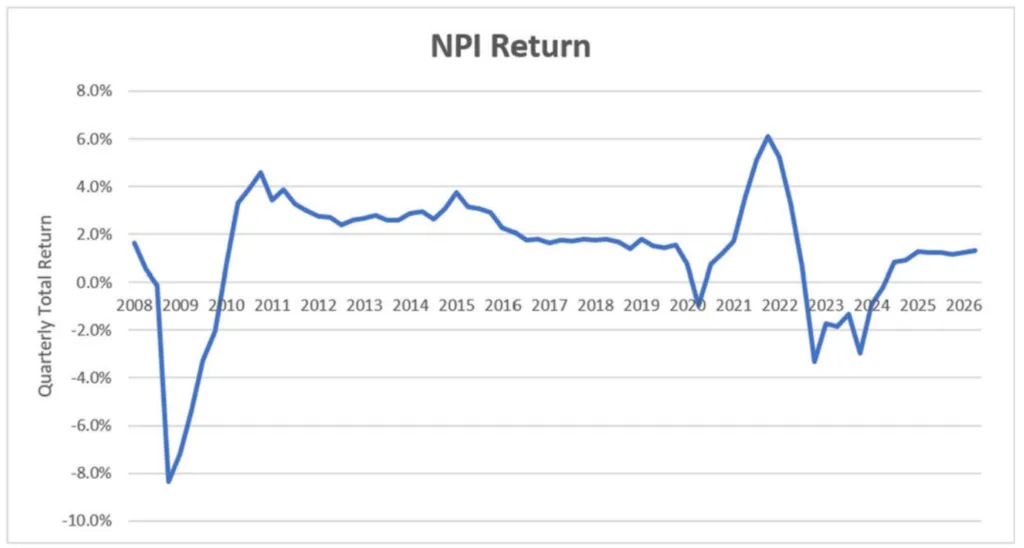
- Institutional real estate posted a 1.29% unleveraged return in Q2 2026, per NCREIF, up from 1.24% the prior quarter.
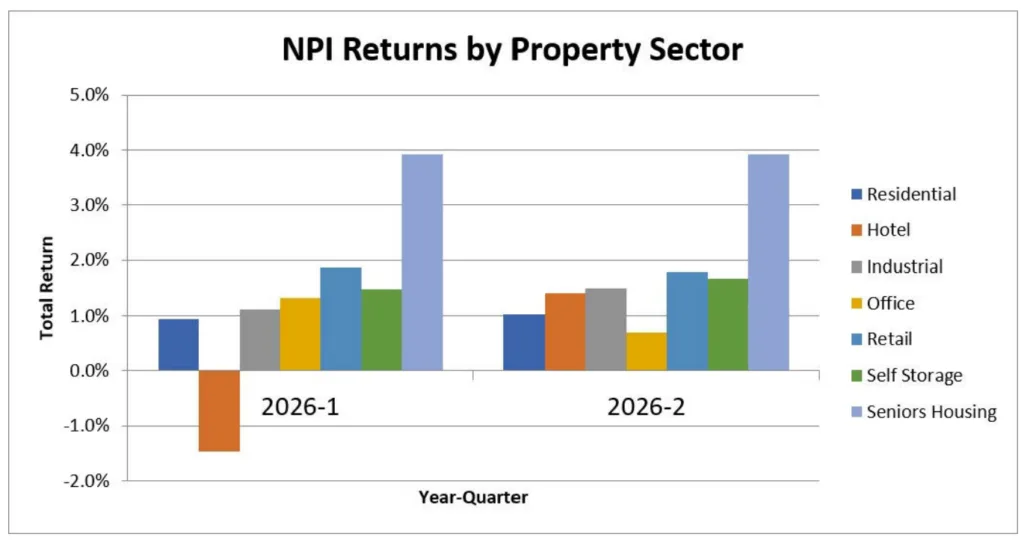
- Seniors housing led all property sectors at 3.91% while office lagged at just 0.70%.
- Sustained return growth marks the strongest 12-month period since Q4 2022, signaling gradual sector-level divergence and continued investor resilience.
Four Quarters of Gains Shape a Rebound Narrative
According to the National Council of Real Estate Investment Fiduciaries (NCREIF), the NCREIF Property Index (NPI) reported its fourth consecutive quarterly rise in institutional real estate returns through Q2 2026. The index, representing 13,160 US investment-grade properties valued at $943B, posted a 1.29% unleveraged return for the quarter, slightly ahead of the 1.24% achieved in Q1. The data, as reported by NCREIF, captures a sustained rebound after a turbulent period in the commercial real estate market.
This quarterly advance delivered a trailing 12-month total return of 5.00%—the highest annualized growth for the index since Q4 2022 and a marked turnaround from prior market volatility. Investors are now closely watching for clarity on whether this momentum will translate to broader sector recovery or if performance gaps between asset types will widen further.
Get Smarter about what matters in CRE
Stay ahead of trends in commercial real estate with CRE Daily – the free newsletter delivering everything you need to start your day in just 5-minutes
Source: NCREIF
The Details
The Q2 2026 performance broke down to a 1.17% income return and a 0.12% capital appreciation. Overall market value in the index increased slightly during the quarter. NCREIF’s sector-level analysis highlighted seniors housing as the top performer, notching a 3.91% quarterly return—matching its strong Q1 figure. Retail (1.80%) and self-storage (1.67%) followed, while industrial improved to 1.49%. Notably, hotels swung back into positive returns at 1.41% after a negative first quarter, though this category remains underrepresented in the index. Residential climbed to 1.03%, but office trailed, falling to just 0.70% after a 1.32% return in Q1, underscoring persistent headwinds for the sector.
Source: NCREIF
Cap rates based on appraisals edged up to 4.63%, while properties that traded in Q2 saw value-weighted cap rates of 5.66%. Quarterly net operating income (NOI) growth hit 1.70%, a slight slip from the previous quarter’s 2.17%, hinting at moderating rent performance in some segments of the market.
Seniors Housing Outpaces, Office Slips Further
Seniors housing has consistently outperformed other property types, benefiting from demographic tailwinds and strong operational performance. Its 3.91% return continues to outpace retail and industrial, which have stabilized but not matched pre-pandemic growth rates. That strength aligns with accelerating senior housing demand entering 2026, supported by demographic growth and tightening availability. Self-storage remains a top contender, rising to 1.67% in Q2 from 1.48% in Q1, reflecting sustained demand for flexible storage solutions.
Office, on the other hand, saw its quarterly return dwindle, reflecting ongoing leasing challenges and a continued flight to quality. Per NCREIF, the sector now stands at just 17% of index value, compared to the industrial (33%) and residential (30%) segments which have grown as institutional portfolios rebalance towards stronger performers.
Why It Matters
The Q2 2026 results reinforce a growing divergence across commercial real estate. While seniors housing and select niche sectors demonstrate strong return profiles, office continues to struggle with softening demand and pricing pressure. According to the NCREIF report, office returns fell to 0.70% for the quarter, a clear contrast to the overall index advance. This disparity mirrors national leasing and capital markets trends, where investors increasingly favor asset classes with rental growth and demographic support.
Sustained NOI growth, though moderating, signals that institutional investors are navigating higher interest rates and operational challenges with renewed discipline. A cap rate increase to 4.63% for appraised unsold assets, coupled with trading deals pushing materially higher at 5.66%, points to continued price discovery and selective liquidity. With $943B now tracked in the NPI, the index remains among the most reliable benchmarks for market participants monitoring risk and reward in US CRE portfolios. This streak of quarterly improvements also restores some confidence after a rocky 18-month period marked by volatility across macro rates and core real estate values.
What’s Next
NCREIF will host a webinar on August 11, 2026, offering deeper insights into sector performance and market trends based on Q2 results. As investors digest four quarters of rising returns, attention will likely turn to whether industrial’s recovery can sustain, if seniors housing can maintain its lead, and when (or if) office might rebound in a meaningful way. The ongoing performance gap between property types will be critical for portfolio strategy heading into the back half of 2026, as will the impact of further economic shifts on asset values and cap rates. The replay and related resources will be available at NCREIF.org.