




- On-time rental payments in non-institutional US units edged down to 83.2% in July 2026, marking a typical seasonal dip but holding above July 2025’s levels.
- Full-payment resolution remains robust at a forecasted 95.4%, while late-payment rates eased to 11.8% in May but continue to run higher than historic averages.
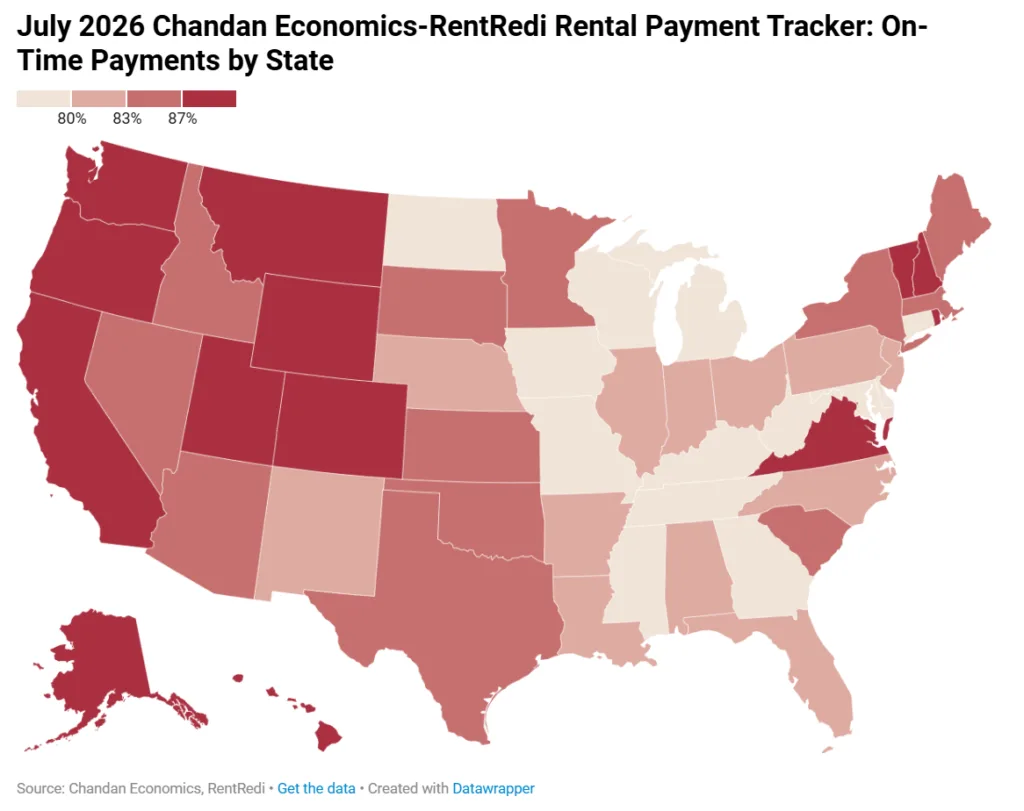
- Western and Mountain states—led by Alaska, Colorado, and Utah—continue to outperform, while the South and parts of the East lag, highlighting continued regional divergence.
Summer Softening, But Stabilization Holds
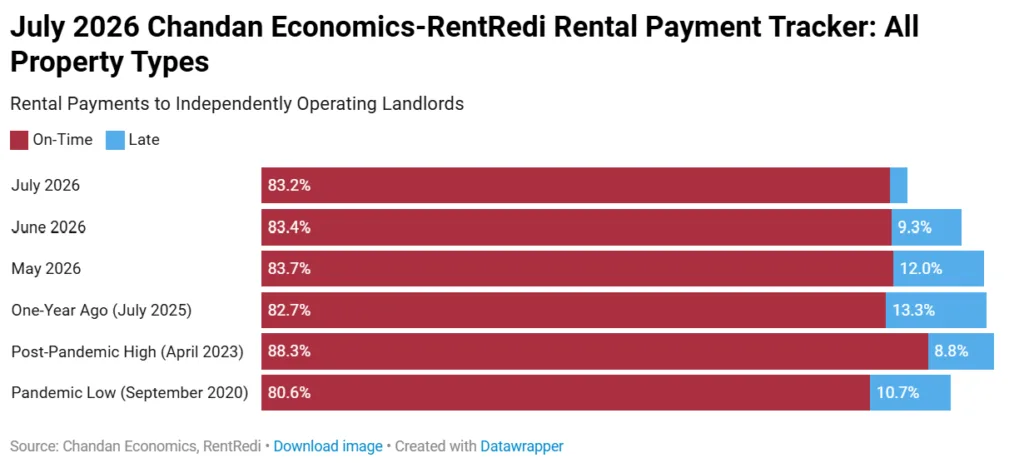
On-time rental payments at mom-and-pop-owned properties dipped slightly to 83.2% in July, according to Chandan Economics. The decline continues a modest downward trend that began in June, suggesting summer seasonality may be influencing payments.
June had already shown collections losing momentum, with independent landlord payment rates stalling after earlier 2026 improvements. However, collection rates remain above July 2025 levels, when the market faced a sharp slowdown. The July data covers 60,391 units tracked through RentRedi. Overall, the figures point toward incremental recovery and stabilization rather than renewed distress.
The improvement comes despite rising living costs, thin renter savings, and historically high credit card delinquencies. Chandan’s three-month moving average shows late payments fell to 11.8% in May. That compares with a 13.5% peak during the first quarter.
This decline suggests some renter financial pressure is easing. Still, payment strain remains above pre-pandemic levels, leaving households vulnerable to further economic shocks.
Get Smarter about what matters in CRE
Stay ahead of trends in commercial real estate with CRE Daily – the free newsletter delivering everything you need to start your day in just 5-minutes
The End of the Post-COVID Payment Rollercoaster
Independent landlords faced considerable volatility over the past 18 months as payment behavior shifted alongside broader economic pressures. Waning pandemic-era support also contributed to changing renter finances.
On-time payment rates fell sharply through late 2025. Since then, the market has entered a period of slow and uneven stabilization. July’s rate increased 53 basis points year-over-year. That gain reverses some late-2025 declines without returning payments to historic highs.
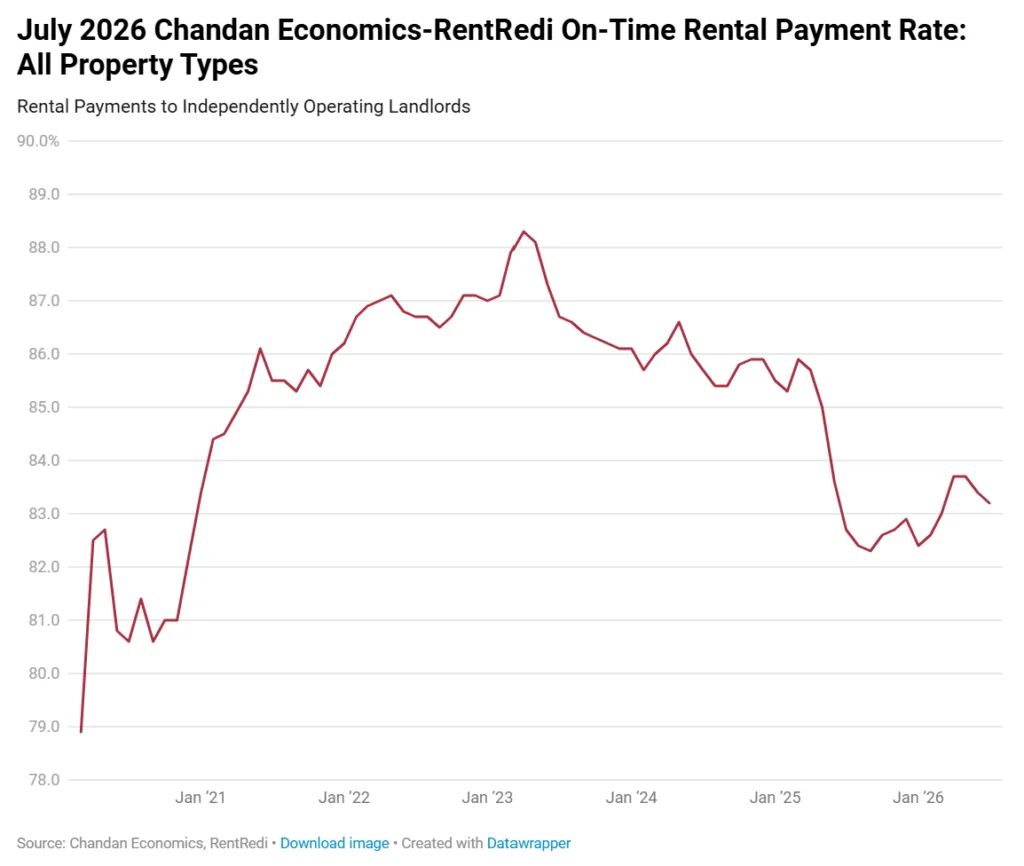
Before the pandemic, on-time payment rates above 85% were common. Current rates remain below those benchmarks, reflecting persistent inflation and a weaker payment environment.
Full-payment rates offer a more reassuring picture. This measure includes both on-time payments and late balances eventually brought current. Chandan forecasts a 95.4% full-payment rate for July 2026. Many tenants still pay late, but most eventually clear their balances, supporting landlord cash flow with some delay.
The Details
Chandan’s July data covers more than 60,000 units tracked through RentRedi, focusing on smaller, non-institutional landlords. The overall on-time payment rate reached 83.2%, slipping from 83.4% in June.
Two-to-four-unit rentals led property types with an 83.8% on-time rate. Single-family rentals followed at 83.4%, while multifamily properties trailed at 81.7%. Performance softened modestly across all property types. However, smaller rental formats continued showing greater resilience.
Late payments improved from winter highs but remain unusually elevated. May’s 11.8% rate fell from 13.5% in January and February. However, double-digit late-payment rates remain above historical norms.
Regional differences also remained significant. Alaska led with 92.9%, followed by Colorado at 91.7% and Utah at 91.0%. Mississippi recorded 68.1%, while Delaware reached 73.6% and West Virginia posted 76.4%. These differences reflect varying economic conditions, household incomes, and affordability pressures.
Late Payments Lose Some Steam, But Strain Remains
Late payments surged throughout 2024 and early 2025 before finally retreating from their peak. The rate fell from 13.5% to 11.8% by May 2026.
Chandan analysts attribute the improvement to gradual household financial adjustments and stronger payment resolution practices among operators. However, late-payment rates still exceed the high single-digit levels common before the pandemic. As a result, many mom-and-pop landlords continue facing unstable monthly cash flows.
Performance also varies considerably across property types. Smaller properties, particularly two-to-four-family rentals, continue showing resilience. Multifamily properties remain weaker, possibly reflecting tenant composition and greater exposure to financially constrained households.
Western and Mountain states have established a strong lead in payment stability. Meanwhile, many Southern markets continue reporting below-average on-time collection rates. Uneven household income growth and cost burdens since 2020 likely contribute to these regional differences.
Why It Matters
For independent landlords, July’s report highlights a challenging but increasingly stable rental market. On-time payments remain especially important for smaller owners operating with limited financial reserves.
Payment rates have stabilized above late-2025 lows but remain below levels commonly recorded before COVID-19. The Joint Center for Housing Studies estimates non-institutional owners manage more than 20 million US rental units. Their payment performance therefore provides an important indicator of broader rental market health.
Late-payment rates near 12% continue creating operational risks for landlords dependent on predictable cash flow. Owners need timely payments to cover debt service, maintenance, taxes, and other expenses.
Still, most late-paying tenants eventually bring their accounts current. The forecasted 95.4% full-payment rate highlights that resilience. However, delayed income can still strain landlords in high-cost and lower-income markets.
Regional results reinforce the uneven nature of the recovery. Alaska, Colorado, and Utah continue outperforming national trends. Meanwhile, weaker performance across Southern and selected Eastern states weighs on national averages.
Chandan’s three-month moving average also reduces short-term volatility and provides operators with a clearer trend baseline. Policymakers can use these patterns to identify markets facing greater distress. That information could help shape targeted responses as affordability pressures continue affecting lower-income renters.
What’s Next
Chandan Economics expects continued economic pressure to test the recent stabilization in rent collections. Many households have depleted savings, while payment timing remains stretched.
Late payments could rise again if living costs increase or labor conditions deteriorate during 2026’s second half. Operators should closely track regional trends as performance gaps widen across states and property types.
Independent landlords may increasingly rely on tenant engagement, flexible payment arrangements, and greater operational efficiency. These approaches could help owners navigate continued payment volatility.
Meanwhile, policymakers and investors will watch for renewed payment stress or stronger progress toward pre-2020 conditions. Chandan’s monthly tracking should provide an important benchmark for measuring that transition.