






- US apartment transaction volume fell to $32B in Q1 2026, marking a sharp slowdown after three consecutive quarters of recovery, according to MSCI Real Capital Analytics.
- Large multifamily deals still cleared at premium pricing, including a $218M Cambridge asset and a record-setting $209M trade in Fort Wayne, Indiana.
- Investors continue to favor apartments over other CRE sectors due to relatively low cap rates and stable fundamentals, even as elevated interest rates pressure deal flow.
US apartment investment sales lost momentum in the first quarter of 2026 as higher borrowing costs and pricing uncertainty pushed many investors to the sidelines. According to MSCI Real Capital Analytics data cited by RealPage, roughly 1,450 apartment properties traded for a combined $32B during the quarter, down 42% from Q4 2025 levels.
The slowdown interrupted three consecutive quarters of improving multifamily transaction activity. Deal count also declined sharply, falling 33% quarter over quarter, while total volume came in well below the sector’s five-year quarterly average of roughly $55B.
Get Smarter about what matters in CRE
Stay ahead of trends in commercial real estate with CRE Daily – the free newsletter delivering everything you need to start your day in just 5-minutes
A Sudden Pause in Multifamily Dealmaking
The pullback reflects a broader recalibration underway across commercial real estate capital markets. Apartment owners and buyers continue to struggle with the gap between seller expectations and today’s financing environment, particularly as interest rates remain elevated compared to pandemic-era lows.
Even with weaker sales activity, pricing has remained surprisingly resilient. Average apartment pricing reached $204,061 per unit in Q1 2026, according to MSCI RCA, extending a streak in which multifamily assets topped the $200,000-per-unit mark in 17 of the past 19 quarters. Before 2021, average pricing had never crossed that threshold and averaged closer to $151,000 between 2015 and 2019.
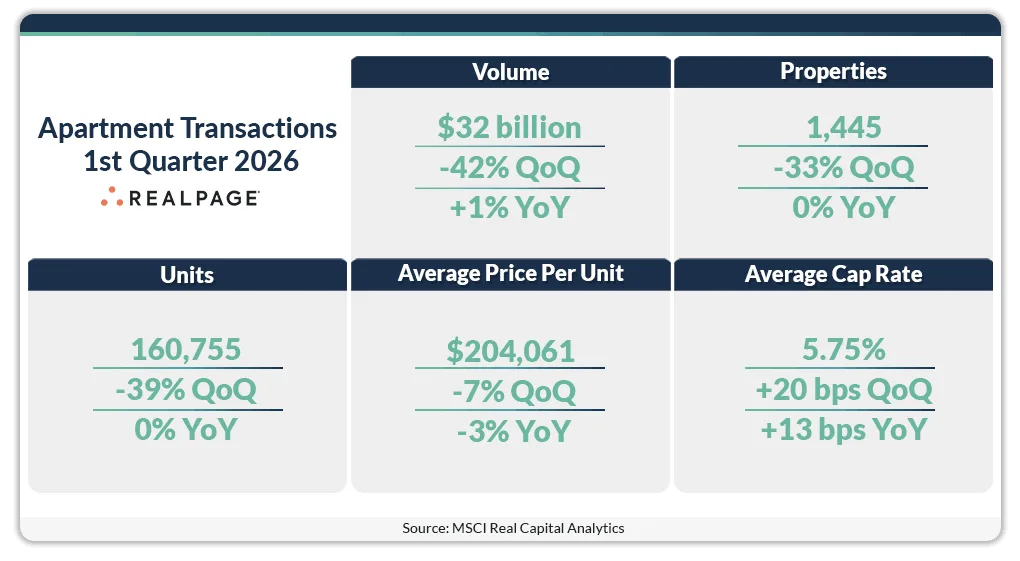
Cap rates also continued trending higher but remained attractive relative to other property sectors. Apartment cap rates averaged 5.75% during Q1, up from the record low of 4.64% recorded in Q2 2022. Still, multifamily maintains the lowest average cap rates among major CRE asset classes, underscoring investor confidence in the sector’s long-term fundamentals.
The Details Behind the Quarter’s Biggest Apartment Trades
Despite the overall slowdown, institutional capital continued pursuing large, high-quality apartment assets in select markets. The five largest multifamily transactions of the quarter ranged from roughly $174M to $218M.
The largest deal closed in Cambridge, Massachusetts, where Chicago-based Mesirow Financial acquired Twenty20, a 355-unit luxury apartment tower in the North Point neighborhood, for $218M. The deal penciled out to roughly $614,100 per unit. Developed in 2015, the property sits within the broader Cambridge Crossing mixed-use district, which includes more than 2M square feet of life sciences space.
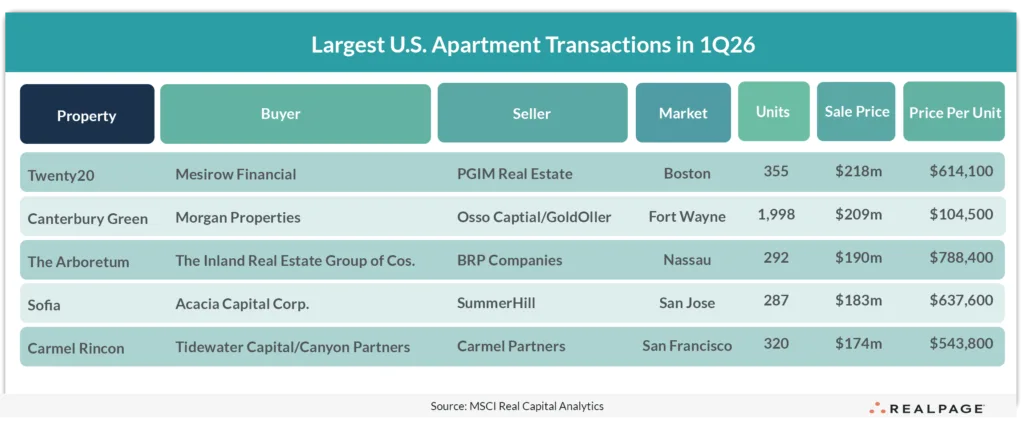
The quarter’s second-largest trade stood out for a different reason: geography. Morgan Properties purchased the 1,998-unit Canterbury Green community in Fort Wayne, Indiana, for approximately $209M, marking the largest multifamily transaction ever recorded in the state. RealPage noted that only one other apartment property in a tertiary market has traded above $210M over the past 25 years.
Other top trades included The Arboretum, a newly developed 292-unit community on Long Island that sold for approximately $190M, and Sofia, a 287-unit San Jose apartment property that traded for more than $183M. In San Francisco, a Tidewater Capital and Canyon Partners joint venture acquired the 320-unit Carmel Rincon property for $174M.
Notably, two of the five largest apartment deals occurred outside major US gateway markets. One landed in Fort Wayne, while another took place in Nassau-Suffolk County on Long Island, highlighting growing investor willingness to pursue scale in secondary and tertiary markets.
Secondary Markets Continue Gaining Institutional Attention
The Fort Wayne and Long Island transactions point to a broader trend reshaping multifamily investment strategy. As pricing in traditional gateway markets remains elevated and rent growth moderates nationally, investors are increasingly targeting smaller metros with stronger affordability profiles and population growth.
That shift has accelerated over the past several years as institutional capital expanded deeper into secondary and tertiary markets. Large operators including Morgan Properties have built acquisition pipelines in Midwest and Sun Belt markets where operating costs remain lower and cap rates offer more yield relative to coastal cities.
At the same time, newly built luxury communities continue commanding premium valuations in supply-constrained suburban markets. The Arboretum on Long Island traded for nearly $788,400 per unit only months after completion, reflecting continued investor appetite for stabilized Class A product in high-income Northeast suburbs.
Annual multifamily transaction activity still showed signs of recovery despite the weak quarter. Over the trailing 12 months ending in Q1 2026, apartment sales volume reached approximately $170.4B across 7,256 properties, according to MSCI RCA. That represented a 6% increase in dollar volume and a 14% increase in property count compared to the prior year.
Why Multifamily Remains the Preferred CRE Asset Class
Even with deal flow slowing, apartments continue outperforming much of the broader commercial real estate market. Office properties remain under pressure from weak leasing demand, while industrial fundamentals have normalized after years of outsized growth. Multifamily, by contrast, still benefits from structural housing shortages and relatively stable renter demand. The weak Q1 showing also follows a brief rebound in broader CRE transaction activity during late 2025, underscoring how uneven the recovery remains across property sectors.
Investors also continue viewing apartments as a defensive asset class during periods of economic uncertainty. According to CBRE’s 2026 US Investor Intentions Survey, multifamily remained the most preferred asset type among commercial real estate investors entering the year.
The resilience in pricing suggests buyers remain confident that long-term rental demand can support current valuations once capital markets stabilize further.
What’s Next
Multifamily transaction activity could remain uneven through the remainder of 2026 as investors wait for additional clarity on interest rates and property valuations. However, large institutional buyers with available capital are likely to keep targeting high-quality assets and scalable portfolios, particularly in markets with strong population growth and constrained housing supply.
If financing conditions improve later this year, apartment investment sales could rebound quickly given the amount of capital still allocated to the sector. For now, Q1’s sharp decline signals that many investors are still in price-discovery mode rather than fully reentering the market.