






- Balance sheet CRE lending spreads barely moved despite recent oil price shocks.
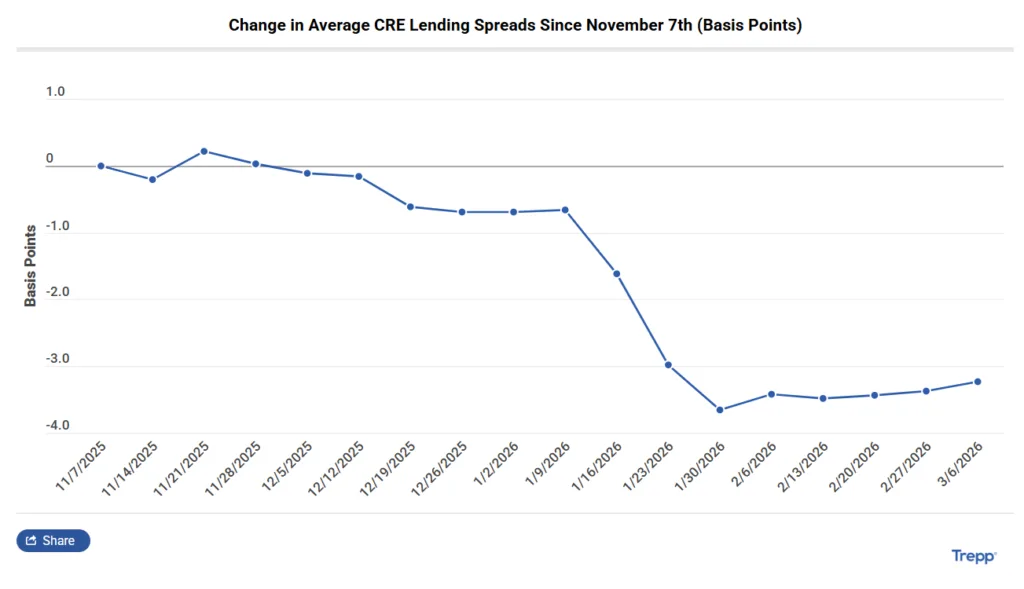
- Trepp-i spreads for low-leverage loans increased by just 0.2 basis points.
- Lenders have not yet priced in extra credit risk from energy-driven volatility.
Spreads Remain Stable
Recent spikes in oil prices due to global tensions have not unsettled balance sheet CRE lending spreads. According to Trepp-i data, spreads across property types registered minimal change, with low-leverage spreads up just 0.2 basis points in aggregate.
This muted response suggests that lenders see oil price volatility as a macro event without direct impact on CRE credit risk. There has been no significant movement in credit spreads, even as energy market headlines have dominated financial news.
Lender Sentiment Holds
For nearly four months, balance sheet CRE spreads have traded in a narrow range, drifting slightly lower into January and mostly flattening out in recent weeks. Lenders seem to be discounting short-term volatility unless it materially affects interest rates or property-level fundamentals.
The lack of a spread spike during the recent oil price surge reinforces this cautious approach. Market participants appear more focused on underlying CRE fundamentals and macro conditions than on external shocks alone, even as energy market volatility has begun influencing broader monetary policy expectations.
What to Watch Next
It remains to be seen whether prolonged energy volatility will eventually affect inflation expectations, borrower costs, or broader risk sentiment. If oil prices persist at higher levels, secondary impacts could emerge, but for now balance sheet CRE lending spreads remain firmly anchored.
Get Smarter about what matters in CRE
Stay ahead of trends in commercial real estate with CRE Daily – the free newsletter delivering everything you need to start your day in just 5-minutes