



Multifamily Permitting: Rebound or Reset?
A modest rebound in permits could signal a period of stability rather than a true recovery.

Nina Dale
March 27, 2026
Together with

Good morning. Multifamily permitting is showing signs of life again after last year’s slowdown, but the recovery is far from uniform. The latest data reflects a market finding its footing amid ongoing challenges.
Today’s issue is sponsored by Cost Segregation Guys—the trusted experts helping investors unlock tax savings and boost returns.
CRE Trivia 🧠
The White House has hidden infrastructure below ground, but what surprising amenity space is included?
(Answer at the bottom of the newsletter)
Market Snapshot
|
|
||||
|
|
*Data as of 3/26/2026 market close.
Permit Pulse
Multifamily Permitting: Rebound or Reset?
A modest rebound in multifamily permits is raising a key question: early recovery or just more of the same?
By the numbers: Multifamily permitting rose to 453,400 units in January 2026—up 5.4% from last year’s ~430,000 low, but still well below the 2023 peak of 650,000, signaling stabilization rather than a full rebound.

A history of plateaus: Permitting doesn’t always follow boom-bust cycles. The industry has seen long stretches of flat activity, averaging ~350,000 units annually from 1998–2007 and ~430,000 units from 2015–2021. Current trends suggest another steady phase may be emerging.
Mixed signals across markets: Roughly half of the top 150 U.S. metros saw permitting rise YoY, while the rest were flat or down; even top markets split, with declines in New York, Austin, and Atlanta and gains of 19%–48% elsewhere.
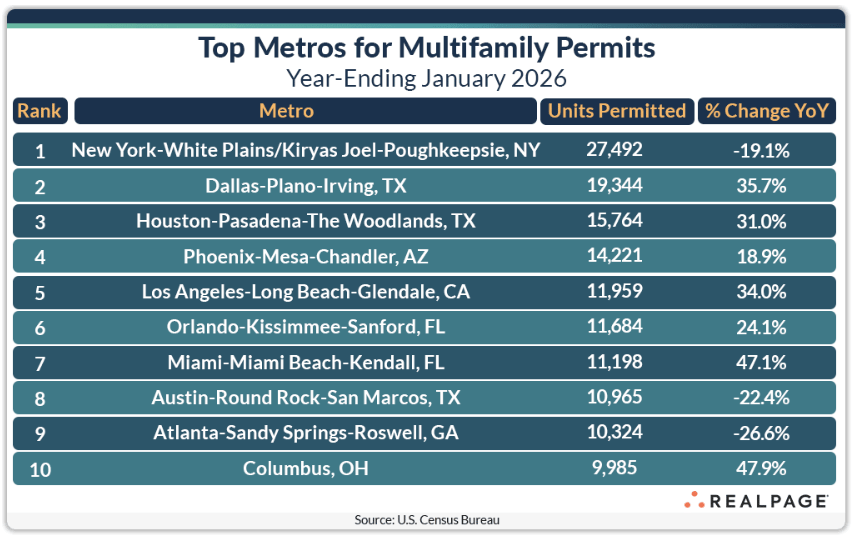
At the city level: Columbus, OH led all municipalities with more than 7,500 units permitted, followed closely by Los Angeles. Miami, Orlando, and Brooklyn also ranked among the most active permitting hubs.
Development headwinds remain: Despite strong housing demand, economic and capital market uncertainty will likely keep development constrained, slowing any near-term supply growth.
➥ THE TAKEAWAY
Uneven outlook: The permitting rebound is real but fragile. Current trends suggest a prolonged period of steady, uneven activity where capital constraints, not demand, will shape new supply.
TOGETHER WITH COST SEGREGATION GUYS
Work With the Nation’s Leading Cost Segregation Experts

There’s a reason real estate investors choose Cost Segregation Guys.
Our engineering-based studies help property owners unlock powerful depreciation strategies, reduce tax liability, and significantly increase cash flow.
*This is a paid advertisement. Please see the full disclosure at the bottom of the newsletter.
✍️ Editor’s Picks
-
From model to market: Henry transforms your raw underwriting into investor-ready OMs, BOVs, and loan packages—built from your data, human-reviewed, and ready to send in minutes. (sponsored)
-
Migration magnet: Sun Belt states lead interstate migration gains while high-cost coastal markets continue to lose residents, reshaping housing demand.
-
Crypto collateral: Fannie Mae is moving toward accepting crypto-backed mortgages, marking a significant step in integrating digital assets into housing finance.
-
Burned by a GP? You’re not alone: Investbase helps real estate LPs share honest sponsor reviews and access exclusive deals — so your experience helps protect the next investor’s capital. (sponsored)
-
AI pushback: Growing opposition to AI data centers is reaching Congress, potentially slowing the expansion of this fast-growing CRE sector.
-
Cooling cashout: KKR’s sale of its data center cooling unit underscores strong investor demand and big returns tied to AI infrastructure.
-
Debt rebound: CRE debt markets closed 2025 on a stronger footing, with improved liquidity signaling a pickup in financing activity.
🏘️ MULTIFAMILY
-
Price convergence: A narrowing bid-ask spread is helping unlock stalled multifamily transactions, bringing buyers and sellers closer to agreement.
-
SBL gap: A pullback by Freddie Mac’s small-balance loan program could tighten financing options for smaller multifamily investors.
-
Luxury leverage: A high-end restaurant is entering the affordable housing debate, spotlighting tensions between development and community needs.
🏭 Industrial
-
Plateau phase: Industrial fundamentals are stabilizing as rent growth cools and vacancies rise slightly following a prolonged boom.
-
Power crunch: Data center development is increasingly constrained by power availability, reshaping where and how projects get built.
-
Cap compression: Industrial net lease cap rates remain relatively low, reflecting continued investor demand despite market normalization.
-
Cold divide: The cold storage sector is splitting between high-demand modern facilities and outdated assets struggling to compete.
🏬 RETAIL
-
Retail rally: Retail sales are projected to grow 4.4% this year, underscoring continued consumer strength despite economic uncertainty.
-
Plano pivot: A major Plano mall redevelopment is moving forward regardless of the Dallas Stars’ involvement, signaling developer commitment.
-
Aldi expansion: Aldi is rapidly expanding in Phoenix, backfilling vacant big-box spaces and boosting retail occupancy.
-
Tenant turmoil: A Charlotte entertainment complex sale could displace tenants, highlighting ongoing instability in certain retail assets.
🏢 OFFICE
-
Pressure points: Office fundamentals remain under pressure as vacancies rise and demand stays muted, signaling a prolonged sector reset.
-
Selloff signal: The U.S. government’s sale of a major D.C. office building underscores shifting space needs and ongoing downsizing.
-
Discount deal: A Boston office asset drawing a $95M lender bid highlights continued pricing pressure and distress in the sector.
🏨 HOSPITALITY
-
Experience capital: Institutional investors are pouring $220M into upscale event spaces, betting on demand for flexible, experience-driven venues.
-
Room reset: FIFA is cutting hotel room blocks for World Cup host cities, easing earlier expectations of massive lodging demand.
-
Membership model: Hotels are increasingly blending private club memberships with lodging, targeting travelers seeking exclusivity and community.
A MESSAGE FROM BULLPEN
Stop Wasting Time on the Wrong Recruiters

Most recruiters send resumes.
We send the right person for your job.
Bullpen partners with real estate investment, development, and lending firms to run high-quality searches—fast.
Fewer candidates. Better fits. Faster hires.
If you’ve been burned before, you’ll feel the difference immediately.
*This is a paid advertisement. Please see the full disclosure at the bottom of the newsletter.
📈 CHART OF THE DAY

U.S. apartment rents declined year-over-year in over 40% of major markets through February 2026, led by steep cuts in supply-heavy Sun Belt metros.
CRE Trivia (Answer)🧠
A single-lane bowling alley sits beneath the North Portico, added in 1969 by Richard Nixon.
More from CRE Daily
-
📬 Newsletters: Stay ahead of the market with local insights from CRE Daily Texas and CRE Daily New York.
-
🎙️Podcast: No Cap by CRE Daily delivers an unfiltered look at the biggest trends—and the money game behind them.
-
🗓️ CRE Events Calendar: The largest searchable calendar of commercial real estate events—filter by city or sector.
-
📊 Market Reports: A centralized hub for brokerage research and market intelligence, all in one place.
-
📈 Fear & Greed Index: A fully interactive sentiment tracker on the pulse of CRE built in partnership with John Burns Research & Consulting.

You currently have 0 referrals, only 1 away from receiving Multifamily Stress Test Model.
What did you think of today's newsletter? |