

Commercial real estate has never lacked for software.
Over the past decade, brokerages have assembled increasingly sophisticated technology stacks: customer relationship management systems to track prospects, marketing platforms to produce listing materials, email tools to promote deals, marketplaces to distribute listings, and transaction software to manage deals once they are under contract.
Each tool promised efficiency. Together, they often deliver the opposite.
According to the 2026 DNA of CRE report, brokers now use an average of seven separate software systems to manage the lifecycle of a single deal, from prospecting to closing. Yet more than 60% of respondents said disconnected tools and duplicate data entry are among the biggest operational challenges facing their brokerage.
In other words, the industry’s technology stack has grown but its workflows haven’t gotten simpler. Instead, the operational burden of managing deals increasingly falls on brokers and their support teams, who spend significant time transferring information between platforms rather than advancing transactions.
It’s a structural problem that many firms have quietly accepted as part of doing business. But that assumption is beginning to change.
The Cost of a Fragmented Workflow
Commercial real estate deals are inherently collaborative. A single transaction often involves brokers, marketing teams, operations staff, finance leaders, attorneys, lenders, and clients all interacting with the same set of property and deal information.
Yet the systems most brokerages rely on were rarely designed to function together. We know that a broker identifies a potential opportunity and logs the contact in a CRM. When the listing is secured, marketing teams recreate property details in separate tools to produce offering memorandums and listing materials. Those materials are then uploaded to multiple distribution channels and emailed to buyers or tenants using third-party marketing platforms. Leads generated from those campaigns are manually re-entered into the CRM. Deal information eventually moves into spreadsheets or back-office systems to manage commissions and financial reporting.
Information must be re-entered and we risk data becoming inconsistent. As brokerages scale and deal volumes grow, those inefficiencies compound creating what industry operators increasingly describe as “operational drag.”
Not to mention, the rise of artificial intelligence has added another layer to the conversation. While many emerging CRE tools emphasize AI-generated reports or market analysis, the more consequential applications may lie in workflow automation.
For brokerages operating in competitive markets, the difference can be significant.
A Shift Toward Unified Platforms
In response, a growing segment of CRE technology companies is attempting to rethink how brokerage software is structured. For many, the path is for joint integrations. Those that work closely with brokerages understand that the value really lives when we aim to unify the entire deal workflow within a single system.
The idea is straightforward: if all stakeholders operate from the same dataset, the handoffs that typically slow deals down can disappear.
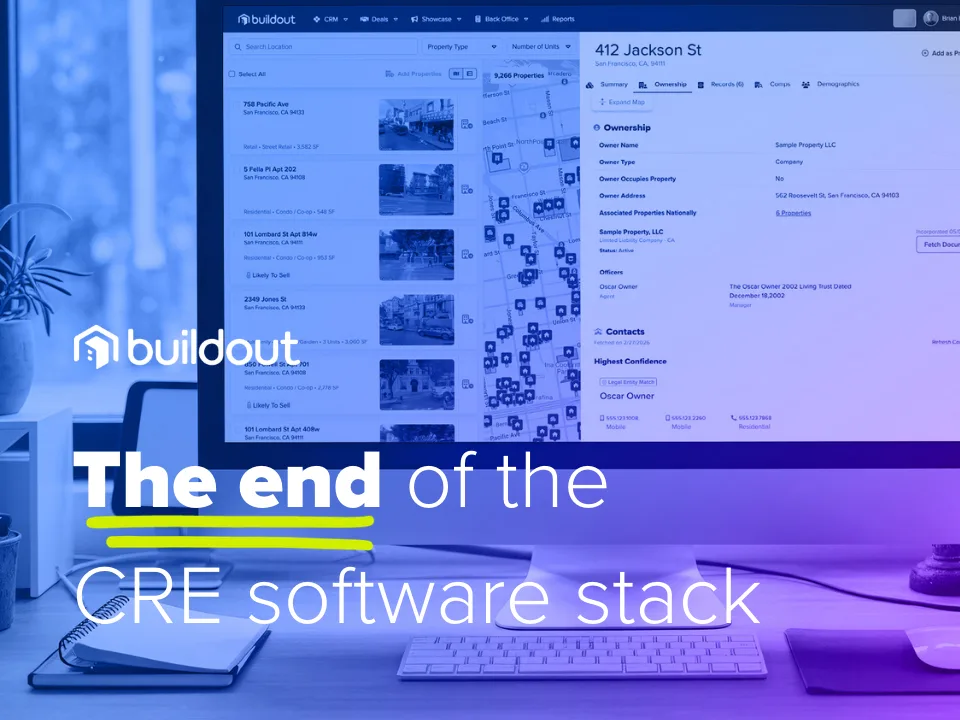
One of the companies pursuing this approach is Buildout, which recently introduced Buildout Suite, a platform designed to connect prospecting, CRM, listing marketing, syndication, deal management, and financial tracking within one environment. The concept reflects a broader industry realization that the traditional “stack” model has reached a point of diminishing returns.
Designing Software Around CRE Workflows
A key challenge for CRE software has always been that brokerage work differs significantly from the traditional sales processes many CRM systems were originally built to support.
What we are used to seeing are deals that revolve around properties rather than just contacts, multiple listings and transactions overlap, teams collaborate across departments, and transaction timelines can stretch over months or years.
These dynamics make it difficult for generic software platforms to fully capture how brokerages actually operate. Buildout’s approach has been to structure its platform around the property and deal lifecycle itself.
When property data enters the system, that information flows automatically into marketing materials, listing websites, syndication channels, CRM records, and transaction workflows. Listings can also be distributed across a network of commercial real estate marketplaces and property platforms to expand visibility. The goal is to eliminate the repeated data entry and manual handoffs that typically occur as deals move from one stage to another.
A Structural Change in CRE Technology
For decades, commercial real estate technology evolved incrementally, with new tools solving specific problems at individual stages of the deal process. The next phase will be defined by replacing them.
On March 10, Buildout introduced Buildout CRM, completing Buildout Suite—a platform designed to manage commercial real estate deals from prospecting through commission.
The system connects prospecting, CRM, listing creation, marketing, syndication, deal management, and financial tracking within a single shared dataset. As deals progress, information moves automatically across teams rather than being re-entered in separate systems. Want to see it to believe? Check out our webinar now.
The idea is simple: the CRE tech stack is ending. Instead of managing software, brokerages manage deals inside one system, from one vendor, built for how commercial real estate actually works.