




- Self-storage REITs saw occupancy rise 0.3% YoY in Q4 2025, the first gain since 2021.
- Street-rate declines moderated to -3.9% YoY, a sharp improvement over 2024’s drop.
- Expense growth slowed, and some REITs posted positive NOI growth in Q4.
- Market performance diverged, with Florida and Texas lagging and Midwest/Northeast cities outperforming.
Stabilization After Volatility
TractIQ reports that self-storage REITs finished 2025 on firmer ground compared to a challenging 2024. The sector’s key operating trends pointed toward recovery, with the moderation of new supply contributing to a more favorable environment. Management teams broadly expect another step forward into 2026 as fundamentals improve across most portfolios.
Rates and Occupancy Improve
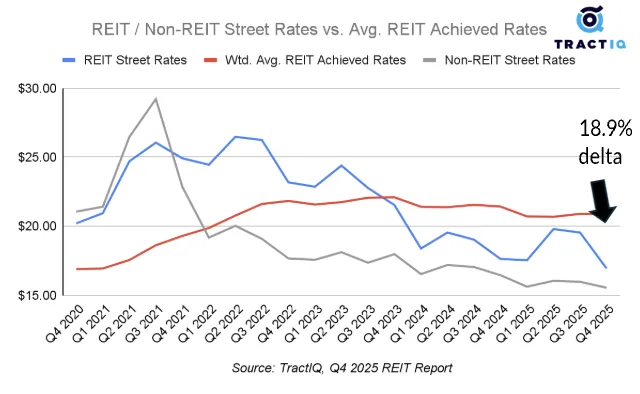
Street-rate declines in self-storage continued in Q4 but at a tempered pace. Self-storage REITs reported a 3.9% year-over-year drop, a notable improvement from the 18.9% YoY decline last year. Achieved rent pressure also eased, with rates down 2.5% YoY, marking the smallest decline since Q3 2024. Meanwhile, occupancy showed positive momentum, posting a 0.3% annual gain—the sector’s first year-over-year increase since late 2021, a sign the sector may be finding firmer footing after a period of slower growth and operational pressure.
Expense and NOI Developments
Expense growth across self-storage REITs slowed in Q4 2025. National Storage Affiliates (NSA) was the only self-storage REIT with an annual expense decrease (-0.8%), while Extra Space Storage reported the only positive same-store NOI growth at 0.1% YoY. These results signal the possibility that NOI may be reaching a trough for the sector as a whole.
Get Smarter about what matters in CRE
Stay ahead of trends in commercial real estate with CRE Daily – the free newsletter delivering everything you need to start your day in just 5-minutes
Market-by-Market Divergence
The self-storage recovery remains uneven across regions. Florida and Texas markets—such as Tampa, Houston, and San Antonio—continued to lag in street-rate performance. In contrast, Midwest and Northeast cities like St. Louis, Richmond, Boston, and Louisville showed greater resilience, hinting at pockets of strength within the self-storage landscape.