


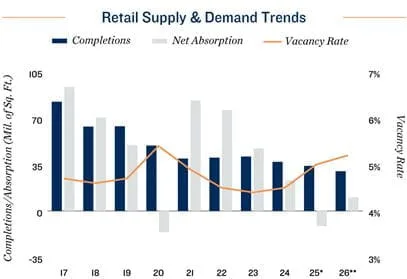
- Retail vacancies held steady near 5.0% in 2025, with open-air centers faring best. Limited new construction continues to support tight conditions in most markets.
- Retail development will hit a record low in 2026, with only 30M SF expected, 70% of which is single-tenant—reinforcing vacancy stability.
- Rising consumer debt levels are mitigated by income growth and record-high savings, supporting steady retail spending.
- Investor sentiment remains bullish, as cap rates stabilize and transaction volume stays above pre-pandemic averages despite policy-driven uncertainty.
A Supply-Driven Stabilizer
The US retail sector enters 2026 in solid shape, despite ongoing economic uncertainty and softening consumer demand, reports Marcus&Millichap. Muted leasing in early 2025, driven by tariff concerns, kept vacancy stable due to a limited and constrained development pipeline.
Retail vacancy hovered near 5.0% through 2025, with many metro areas falling below the 4.0% threshold. Open-air centers outperformed malls, where vacancies remain above 9.0%. The gap between anchored and unanchored centers has narrowed significantly since 2020, reflecting long-term supply constraints.
Construction stayed muted, with under 10M SF of multi-tenant retail delivered through Q3 2025—the slowest pace since 2012. The trend continues, with just 30M SF projected for 2026, over 70% of which will be single-tenant formats.
Consumers Still Spending, For Now
Rising consumer debt levels are sparking concerns, but the broader picture offers some reassurance. Total household debt reached a record $18.5T, including $1.7T in auto loans and $1.2T in credit card balances. Yet when adjusted for income, these figures remain in line with long-term norms.
Healthy wage growth and $25.4T in savings as of Q3 2025 suggest consumers aren’t under major financial stress yet. This financial resilience supports retail activity, even as return-to-office efforts slow from labor shortages and rising wage pressure.
Get Smarter about what matters in CRE
Stay ahead of trends in commercial real estate with CRE Daily – the free newsletter delivering everything you need to start your day in just 5-minutes
Investment Confidence Carries Forward
Retail real estate investment remained resilient through 2025, and that momentum is likely to continue in 2026.
Despite modest vacancy increases and subdued rent growth expectations, investors remain focused on the sector’s fundamentals. Cap rates stabilized near 6.8%, with single-tenant assets in the mid-6% range and multi-tenant properties in the mid-7% range.
Total transaction volume in 2025 came in 12% above the 2014–2019 average, reinforcing the bullish sentiment. Uncertainty around tariffs and federal policy could introduce new risks. Still, low supply, stable performance, and consumer strength support ongoing investor interest.
Bottom Line
The US retail market is entering 2026 with its footing intact. Limited new supply, steady investor activity, and consumer fundamentals are offsetting economic and policy challenges. Volatility remains a risk, especially from geopolitical and regulatory factors. However, disciplined development and investment may keep the sector stable in 2026.