


- Remote work has stabilized at 13.3% of the US workforce in 2024, signaling a long-term shift rather than a temporary trend.
- Hybrid work dominates, with remote workdays nearly 4x higher than pre-pandemic levels, even as fully remote jobs remain in the minority.
- Suburbs have become remote work hubs, but high-amenity urban areas like Santa Monica and Berkeley remain strongholds.
- Metro areas like Denver, Austin, and Raleigh lead the shift, while reduced commuting continues to impact transit systems and downtown economies.
Remote Work Isn’t Reversing — It’s Evolving
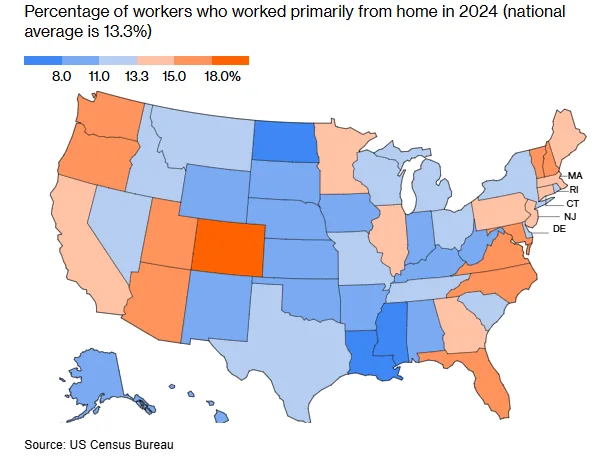
According to newly released US Census Bureau data, 13.3% of American workers primarily worked from home in 2024. That’s down slightly from 13.8% the previous year, reports Bloomberg. That small decline, combined with data from WFH Research, shows a new trend. The average number of remote workdays has held steady at 27.7%. Together, these signals suggest that remote work has reached a post-pandemic equilibrium.
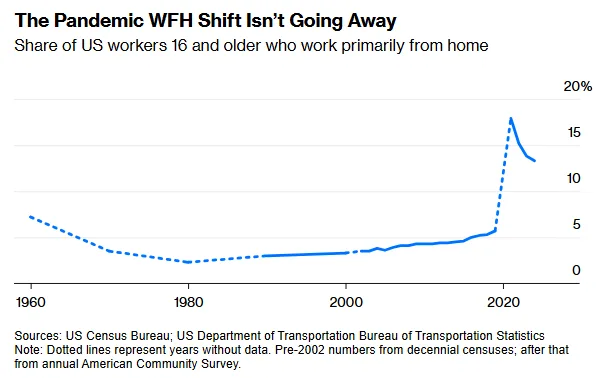
Remote work is no longer a pandemic-driven anomaly. It’s now a permanent fixture of the American workforce — albeit not the dominant one.
Hybrid Work Dominates The Landscape
While fully remote jobs are less common, hybrid models have emerged as the prevailing structure. Compared to 2019, the share of Americans working from home in 2024 was 2.3x higher — and the number of remote workdays 3.8x greater. The data suggests that flexibility, rather than full autonomy, is the defining trait of the post-Covid workplace.
Get Smarter about what matters in CRE
Stay ahead of trends in commercial real estate with CRE Daily – the free newsletter delivering everything you need to start your day in just 5-minutes
Suburbs Take The Lead — But Cities Still Compete
In 2021, big-city neighborhoods topped the list of work-from-home (WFH) hotspots. Today, that top tier is mostly suburban — but urban communities haven’t vanished from the rankings. Affluent enclaves like Santa Monica and Berkeley still make the top 25 for WFH concentrations, offering lifestyle-rich alternatives to more space-focused suburbs.
The top WFH areas now fall into two main camps:
- Spacious suburbs with ample home office space
- Dense urban areas with amenities and lifestyle appeal
While urban flight defined early pandemic moves, many remote workers are staying — or returning — to cities.
Where Remote Work Is Most Prevalent
Metro areas leading the WFH charge include:
- Denver-Boulder-Fort Collins
- Austin
- Raleigh-Durham
- San Francisco Bay Area
- Washington, DC
Notably, most of these metros also have lower-than-average public transit use, suggesting that remote work has made a bigger dent in solo driving than in train or bus commuting.
What Remote Work Means For Transit And Cities
While only 1.3 percentage points of the drop in commuting came from transit, that has been enough to destabilize major urban systems. Cities like New York, with relatively lower remote work shares (12.5% in 2024), have fared better economically. On the other hand, Denver, a WFH leader, is battling downtown commercial vacancies and a sluggish restaurant recovery.

Urban areas aren’t disappearing — but they’re evolving in ways that challenge traditional urban planning and commercial real estate models.
Where Remote Work Is Still Rare
Low-WFH areas are often:
- Rural
- Lower-income
- Blue-collar-heavy
Some exceptions exist — such as parts of Los Angeles and New York City — but many of the bottom 25 areas for remote work remain outside large metro economies.
Remote Work By Region: The Coasts (And Colorado) Lead
Remote work remains most prevalent along the coasts and in Colorado, with heartland states trailing. State-level WFH rates tend to correlate with the presence of large, economically diverse metro areas — something many interior states still lack.
What’s Next
The dream of working from a remote beach or a mountain town lives on for some — but for most, remote work is reshaping life within metro regions, not outside them. The biggest winners? Suburbs. But cities are holding on, especially those that can adapt to a workforce that’s staying local, even when it’s not going into the office.
Expect hybrid models to continue dominating the conversation as employers, developers, and policymakers adjust to a workforce that has fundamentally — and perhaps permanently — changed its commute.