






- Opportunity Zone eligibility will shrink by 25% nationwide in the next cycle.
- Stricter median family income thresholds will focus designations on more distressed areas.
- California and Texas will retain the most Opportunity Zone designations, but some Southern states will see increases.
- OZ 2.0 introduces enhanced incentives for rural areas and tighter compliance standards.
New Eligibility Requirements
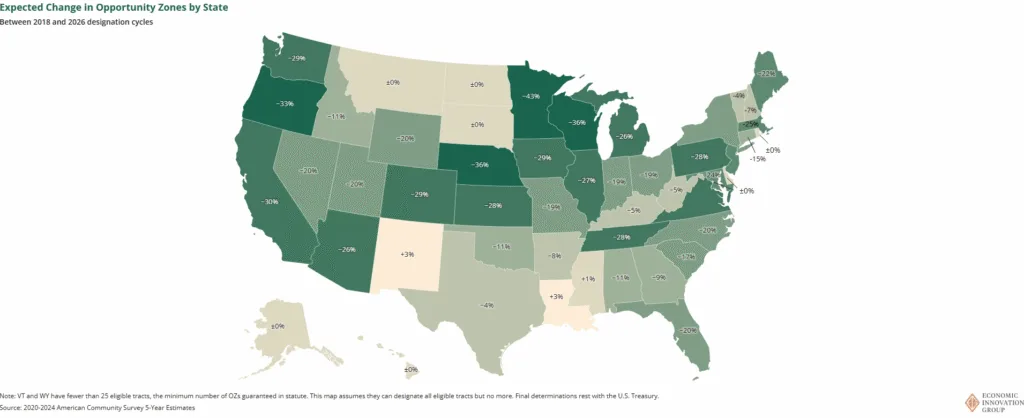
Multi-Housing News reports that recent changes to Opportunity Zone criteria will tighten eligibility starting in January 2027. Lawmakers approved the changes under the One Big Beautiful Bill Act. New census data shows that only tracts with median family income at or below 70% now qualify, down from the prior 80% threshold. As a result, eligible tracts will drop from 7,826 to 6,293 nationwide, according to Economic Innovation Group data. This shift represents a 25% overall reduction in Opportunity Zone eligibility.
Concentration Shifts and State Impacts
Opportunity Zone designations will concentrate most heavily in California and Texas, with each projected to retain more than 600 zones. New York, Florida, and Ohio will follow with the next highest totals nationwide. Meanwhile, Louisiana, Mississippi, and New Mexico will gain eligible tracts due to rising economic distress. With fewer zones available, governors must act more strategically when selecting designations. Consequently, each choice will carry greater importance for future investment outcomes.
Focus on Distressed and Rural Areas
The revised criteria aim to direct investment toward more deeply distressed and underserved communities. Housing-constrained and economically challenged areas will receive greater attention under the updated rules. At the same time, lawmakers are advancing reforms that would strengthen oversight and refine incentives, signaling sustained federal support for the program’s next phase. Since late 2019, Opportunity Zones have helped finance roughly 313,000 residential units nationwide. However, future development totals may decline as eligibility narrows across states. OZ 2.0 also requires that at least 25% of zones be located in rural areas. Additionally, lawmakers expanded incentives to attract capital into rural markets. Investors in rural zones can now defer up to 30% of capital gains, up from the previous 10%.
What’s Next
The Treasury Department is expected to release additional guidance ahead of the January 2027 cycle. Meanwhile, investors and policymakers are preparing for sharper competition among states. Greater accountability will influence how governors select Opportunity Zones going forward. Ultimately, the program will focus on generating measurable economic impact in the nation’s most distressed communities.
Get Smarter about what matters in CRE
Stay ahead of trends in commercial real estate with CRE Daily – the free newsletter delivering everything you need to start your day in just 5-minutes