


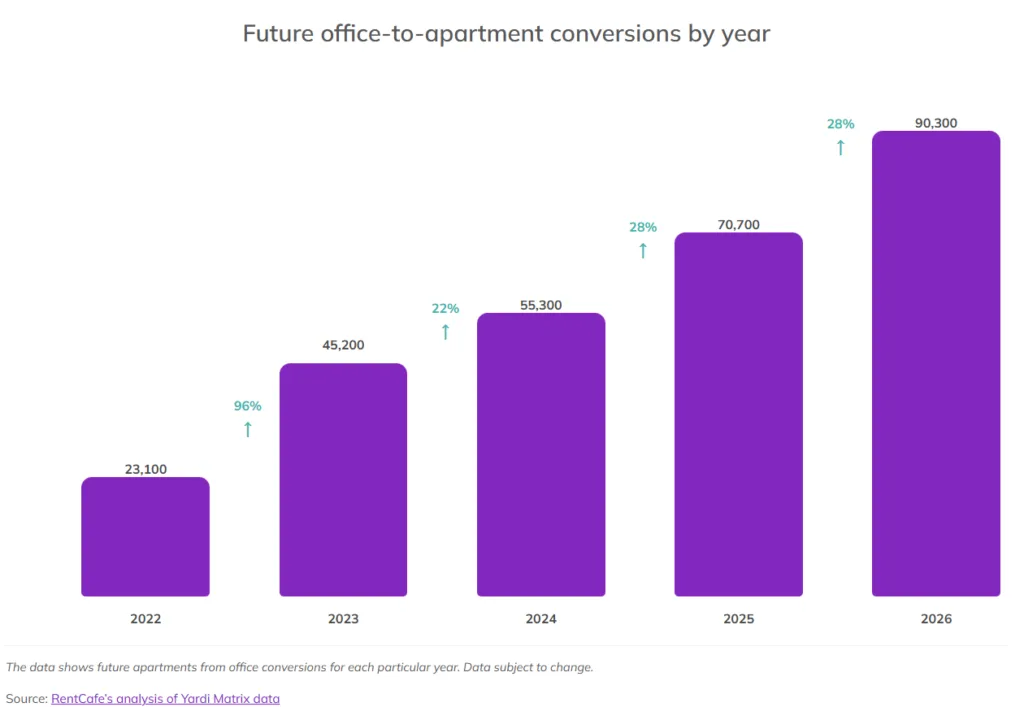
- Office conversions for apartments reach 90,300 units in 2026, a 28% increase year-over-year.
- Office conversions now make up 47% of all adaptive reuse projects nationwide.
- New York, Washington, D.C., and Chicago lead the ranking for most conversions in progress.
- Philadelphia, Denver, and St. Louis more than doubled their conversion pipelines year-over-year.
Record Growth for Office Conversions
According to RentCafe, office-to-apartment conversions are accelerating across the US. Developers have 90,300 rental units in the pipeline as of early 2026. That marks a 28% year-over-year increase and nearly four times the 2022 total. Meanwhile, vacancy rates remain near 20%, while remote work continues to disrupt traditional leasing. As a result, owners and developers are reimagining underused office space to meet housing demand.
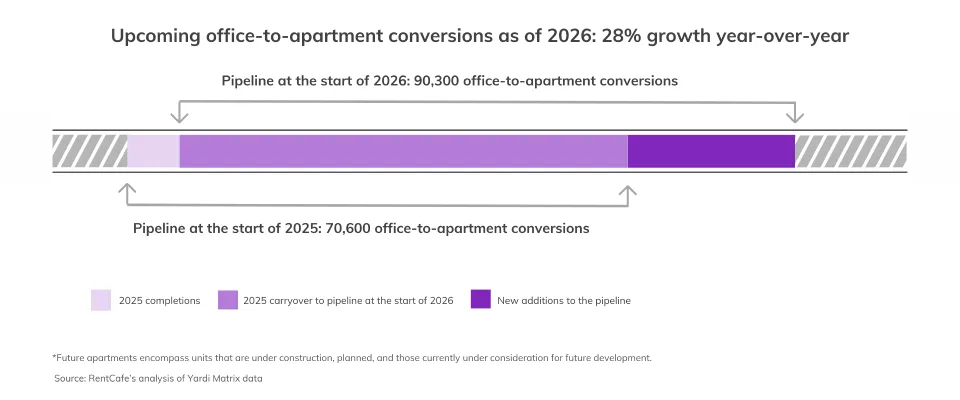
Conversions now represent nearly half of all future adaptive reuse projects and are gaining ground in both major and mid-sized markets. Financial pressures, upcoming loan maturities, and local government incentives are fueling the wave of office conversions in 2026.
Major Markets and Fastest Risers
New York leads with 16,358 office conversions in the pipeline, followed by Washington, D.C. (8,479) and Chicago (4,360). Los Angeles and Dallas also post strong totals. Notably, Denver, Philadelphia, and St. Louis each more than doubled their conversion pipelines this year, moving up in national rankings as adaptive reuse activity broadens geographically.
In 12 of the top 20 metros, office conversions make up above 50% of adaptive reuse projects, with Dallas and Minneapolis reaching 82%. Conversion activity is now expanding beyond historic downtowns into suburban and secondary markets, enabled by supportive local policies.
Get Smarter about what matters in CRE
Stay ahead of trends in commercial real estate with CRE Daily – the free newsletter delivering everything you need to start your day in just 5-minutes
Why Office Conversions Are Rising
High office vacancy and strong housing demand are primary drivers for office conversions. More than 1.9B SF of office space nationwide, or roughly 24% of office inventory, is rated suitable for conversion, based on Yardi Matrix’s Conversion Feasibility Index. Not every office property can be repurposed, but footprint, natural light, and location near transit are key success factors.
Government incentives, including tax breaks and zoning changes, are improving project feasibility. Cities like New York, Washington, and Los Angeles continue to lead these efforts. Meanwhile, developers are also exploring alternative reuse strategies, including converting aging properties into self-storage as demand shifts across asset types. Upcoming loan maturities totaling $213B by 2026 are adding urgency for many owners.
Region and Building Type Breakdown
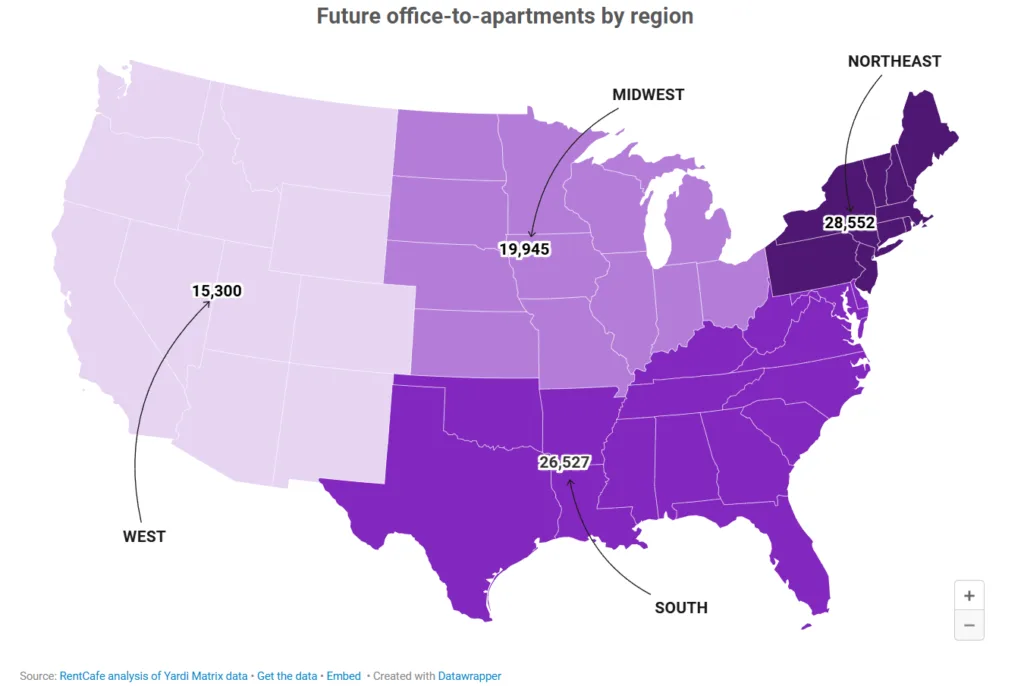
The Northeast leads active conversions with 28,552 units, closely followed by the South at 26,527. The Midwest and West account for 19,945 and 15,300 units, respectively. Conversions target mostly older office buildings, but the share involving newer properties is on the rise, now at 6.4% of future office conversions.
By building type, offices represent 47% of all planned adaptive reuse apartments nationwide. Hotels and industrial properties follow at 18% and 16%, respectively.
Looking Ahead
Office conversions have moved from a niche solution to a central strategy for housing delivery in many US cities. Persistent office vacancy, growing demand for urban living, and supportive local policy point to continued momentum in office conversions as part of broader adaptive reuse trends in 2026 and beyond.