


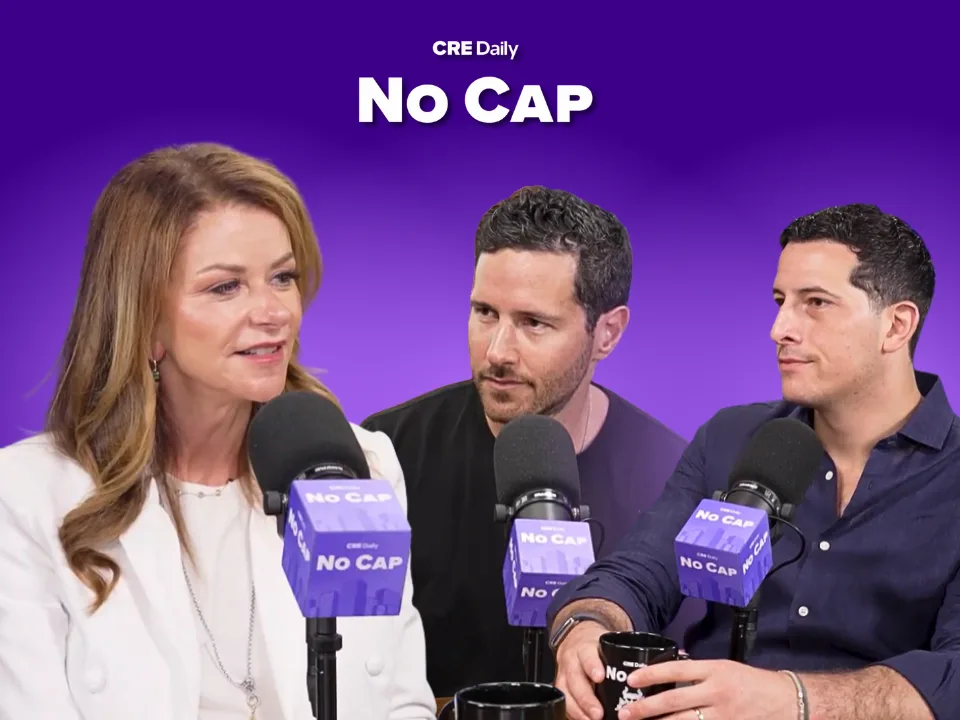
In Season 3 of the no cap podcast, Jack Stone and Alex Gornik sit down with MaryAnne Gilmartin — founder and CEO of MAG Partners and former president and CEO of Forest City Ratner Companies. Over more than three decades, she has led some of New York City’s most complex and high-profile developments, including the New York Times Building, Barclays Center, and Pacific Park. A self-described “placemaker,” Gilmartin is known for fearlessly taking on projects that redefine housing, balancing public benefit with private investment, and leading through political and economic headwinds.
In this episode, Gilmartin shares how a scrappy upbringing prepared her for the unpredictable nature of real estate, the behind-the-scenes battles that defined her career, and why she still believes New York can tackle its housing crisis.
Conversation Highlights
Alex: For those who don’t know your story, how did you get started in development?
MaryAnne Gilmartin: “Pure serendipity. I had a life plan, but I was ready to rip it up. Fear holds people back. I’m not afraid. I landed a fellowship under Mayor Ed Koch, working on transformational city projects when development wasn’t glamorous. That experience taught me to navigate tough neighborhoods, sell tough stories, and sharpen my skills. I didn’t even know what economic development was when I started. One day I’m sitting in Ed Koch’s office, and the next I’m in a bulletproof limousine crossing the Brooklyn Bridge to convince a bank to stay in the city. That’s when I learned the job was about more than buildings — it was about selling a vision.”
Jack: You’ve called yourself a placemaker. What does that mean in New York?
MaryAnne Gilmartin: “It’s about shaping entire neighborhoods, not just putting up buildings. You can’t learn it in a book. You only know it by doing it. My work has spanned office, residential, retail, hotels, arenas. That versatility changes how you see value.”
She recalled one of her proudest wins: securing the New York Times Building.
Alex: Tell us about winning the New York Times Building project.
MaryAnne Gilmartin: “Everyone told us not to bother. We were ‘Brooklyn developers,’ but knew 42nd Street inside out. Our team were great builders, we brought everyone to the pitch, and we weren’t afraid to make it human. An intern even burst into the meeting dressed as a paperboy, cut a giant construction schedule in half, and made the room laugh. It worked.”
Jack: And then Barclays Center. How did that land on your desk?
MaryAnne Gilmartin: “One day Bruce Ratner told me, ‘You’re running the project.’ It was the ultimate test: lawsuits, opposition, economic crisis, 60 different property owners, and the state’s use of eminent domain. We had to finish the arena and open a new subway station at the same time. That subway nearly killed us. A $7M estimate turned into $72M, but without it, the arena couldn’t open. We pulled it off in time for Jay-Z’s sold-out shows.”
When you build under a microscope, every single move matters.
We asked about the larger challenges of making projects viable in such a high-stakes environment.
Jack: What’s the hardest part about developing in NYC?
MaryAnne Gilmartin: “Balancing public benefit with project viability. Pacific Park is a prime example. Six hundred public meetings, constant oversight, and obligations piled onto the private sector. Some elements improved, but the project suffered death by a thousand cuts. Thousands of housing units remain unbuilt because the capacity and political will aren’t there. When people said it was a backroom deal, I reminded them we’d held over 600 public meetings. That kind of process changes you as a developer — you have to listen, but you also have to know when to say no for the project to survive.”
Alex: Given the current political climate, are you optimistic about NYC’s housing future?
MaryAnne Gilmartin: “The only addiction I favor is staying addicted to hope, but hope isn’t a plan. We have a housing emergency, and every candidate now agrees we must act. It’s harder than ever, but also more compelling than ever. I’m unapologetic about what I do because I believe we do it well. We make cities better places to live. That’s the legacy I want.”
I don’t need somebody to like me. I need somebody to understand what I can do to make the city better. And I know that I can do that with my team.
Watch the full episode on our YouTube Channel or your favorite podcast app.
Tune in weekly for new episodes of No Cap by CRE Daily!