



- Innovation is spreading beyond traditional hubs, but a shortage of modern, investment-grade space is creating a global supply crunch.
- Only a small portion of office inventory has been built in recent years, pushing companies toward higher-quality assets and driving up rents.
- Emerging “reinforcer” cities are gaining momentum, offering more affordable options while attracting talent and capital.
Innovation is no longer concentrated in a handful of global cities, and that shift is reshaping the commercial real estate landscape. According to JLL’s 2026 Innovation Geographies report, companies are expanding into a broader range of markets, but the supply of high-quality, investment-grade space has not kept pace with demand.
As a result, competition for premium office space is intensifying, forcing occupiers and investors to rethink where—and how—they operate.
Get Smarter about what matters in CRE
Stay ahead of trends in commercial real estate with CRE Daily – the free newsletter delivering everything you need to start your day in just 5-minutes
A supply crunch years in the making
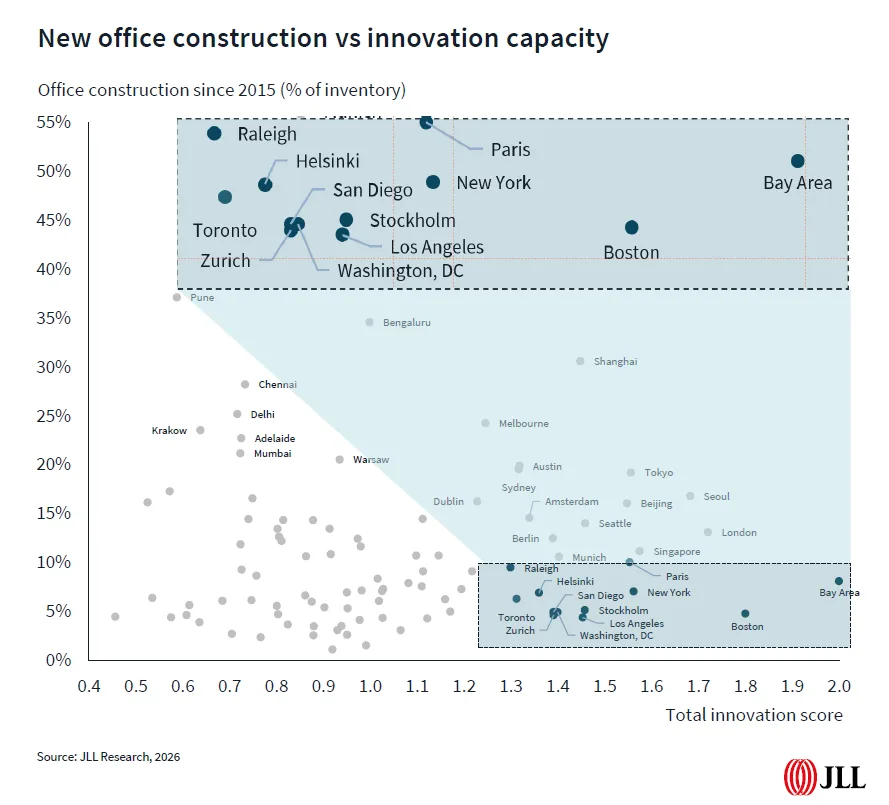
The imbalance between supply and demand is rooted in years of underbuilding. Globally, only 11% of office inventory has been delivered since 2020, leaving a limited pool of modern buildings that meet today’s tenant expectations.
In major innovation hubs such as the Bay Area, New York, Boston, and London, the situation is even more constrained. Much of the existing inventory is older, and new construction has struggled to keep up due to rising costs and tighter development conditions.
This shortage is especially problematic because companies are no longer satisfied with basic office space. Instead, they are prioritizing high-quality environments with strong amenities, accessibility, and design—features typically found only in newer buildings.
Innovation spreads beyond traditional hubs
At the same time, innovation itself is becoming more geographically diverse. While traditional powerhouses like the Bay Area and London remain dominant, growth is accelerating in a broader set of cities.
JLL identifies a group of “reinforcer” markets—including Austin, Amsterdam, and Shanghai—that are emerging as key innovation centers. These cities are attracting significantly higher population inflows than traditional hubs, driven by a mix of affordability, lifestyle appeal, and expanding business ecosystems.
This shift is giving companies more flexibility in site selection, allowing them to balance cost considerations with access to talent and infrastructure. However, even in these emerging markets, the demand for high-quality space is rising quickly.
A widening gap between quality tiers
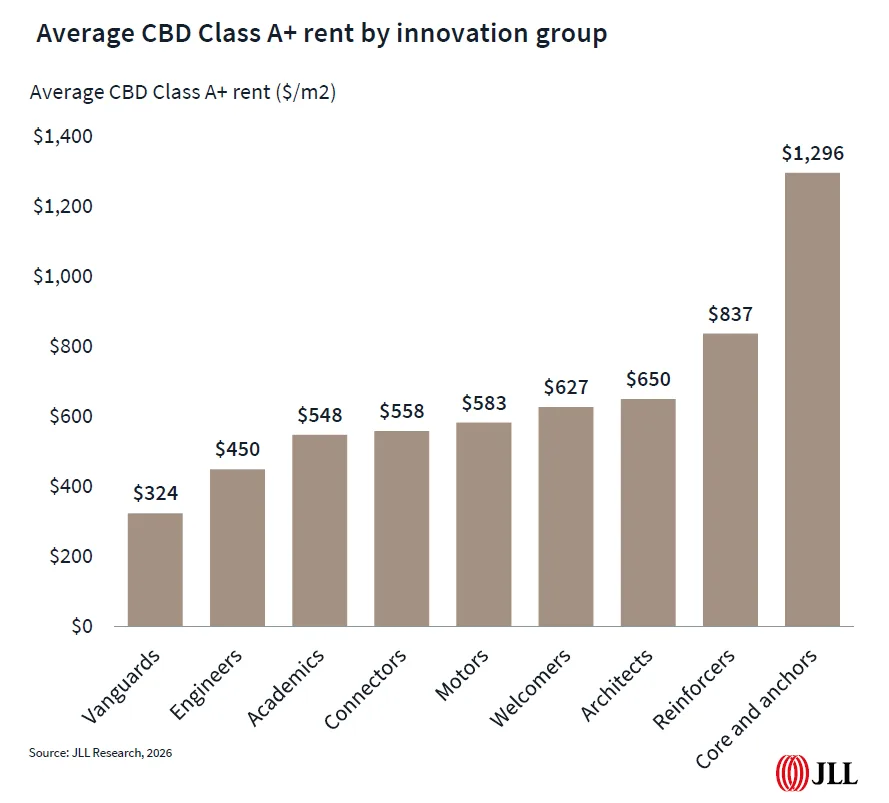
The shortage of premium space is creating a clear divide within office markets. High-quality, newly built properties are seeing strong demand and rising rents, while older buildings face increasing vacancy and obsolescence.
In leading cities, prime office rents have surged to more than $1,200 per square meter on average, reflecting intense competition for limited supply.
Meanwhile, some emerging markets offer significantly lower costs, creating opportunities for companies willing to expand beyond traditional locations. This pricing gap is reshaping how occupiers approach their real estate strategies, with many consolidating into fewer, higher-quality spaces.
Opportunities for investors and developers
For investors, the current environment presents both challenges and opportunities. The lack of available premium assets is driving competition, but it is also creating strong incentives to develop, redevelop, or reposition properties.
In particular, cities that combine strong innovation growth with relatively low levels of real estate investment are likely to attract increased capital. Northern European markets such as Copenhagen, Amsterdam, and Frankfurt stand out as potential beneficiaries of this trend.
Developers, meanwhile, are under pressure to deliver spaces that go beyond traditional office formats. Mixed-use environments, amenity-rich buildings, and well-connected locations are becoming essential to meet evolving tenant demands.
Why it matters
The relationship between innovation and real estate is becoming more tightly linked. Companies are no longer choosing locations based solely on cost or scale—they are focusing on the quality of the built environment and its ability to attract and retain talent.
This shift is elevating the importance of “place,” where factors such as accessibility, amenities, and overall experience play a critical role in real estate decisions.
What’s next
Looking ahead, the supply-demand imbalance is unlikely to ease in the near term. New construction remains constrained, and demand for high-quality space continues to grow.
As a result, expect more redevelopment of older buildings and increased investment in emerging innovation hubs. Cities and developers that can deliver modern, flexible, and highly amenitized environments will be best positioned to capture future demand.
In a market defined by scarcity, premium space is no longer a luxury—it is becoming the baseline for competing in the global innovation economy.