



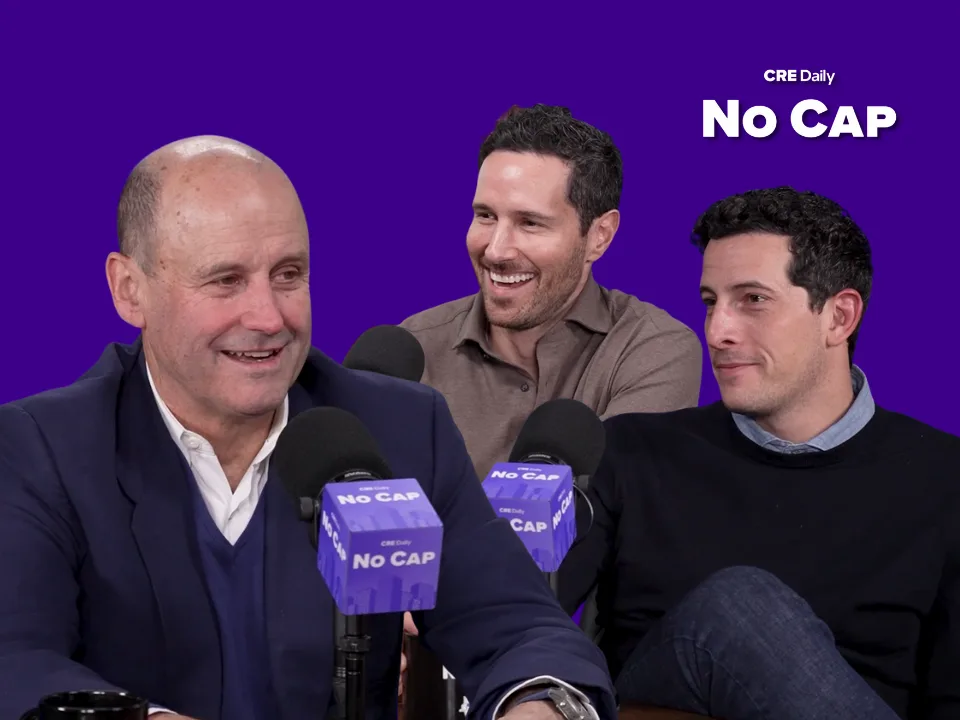
Season 5 of the No Cap podcast continues as co-hosts Jack Stone and Alex Gornik sit down with Edward Pitoniak, President and CEO of VICI Properties.
Born out of Caesars’ bankruptcy less than a decade ago, VICI has become the dominant owner of experiential real estate in the world. Its portfolio spans some of the most iconic assets on the Las Vegas Strip — including Caesars Palace, The Venetian Resort, The Mirage, and Mandalay Bay — properties defined not by square footage, but by irreplaceability.
In this episode, Edward breaks down how VICI reframed gaming assets as institutional-grade real estate, why storytelling matters as much as underwriting, and what the next era of experiential investing could look like.
Conversation Highlights
Alex: Before we get into VICI, tell us how you got here. What’s your backstory?
Edward: I actually started in the magazine business. I spent 17 years in New York, eventually becoming editor-in-chief of Ski Magazine. That period taught me something that stayed with me forever — how to tell stories with numbers. That’s what finance really is.
That early focus on demographics and storytelling shaped how Ed later approached real estate investing.
Jack: How did that lead you into real estate?
Ed: I joined InterWest in the mid-90s. At the time, we were rolling up ski resorts across North America, but we quickly realized we hadn’t figured out how to integrate acquisitions. As a result, I built a team across operations, finance, HR, marketing, and food and beverage so that we could lift every resort to benchmark performance. Through that process, I learned how to scale excellence and apply operational discipline across complex portfolios.
Alex: How did you make the jump to being a public REIT CEO?
Ed: In 2004, I became CEO of a Canadian hotel REIT. By 2007, our stock price had outrun fundamentals. We ran a mean reversion analysis and decided to sell from a position of strength.
The REIT was sold to a Canadian pension fund just before the global financial crisis.
Alex: Let’s talk about VICI. How did it come out of Caesars’ bankruptcy?
Ed: The idea, therefore, was to separate real estate from operations. At the time, creditors didn’t want to run casinos; instead, they were focused on securing long-duration cash flows. As a result, conveying the real estate into a REIT emerged as an elegant solution that ultimately worked for everyone involved. However, Wall Street remained deeply skeptical. In fact, the informal project name was “Project Shitco.”
Jack: Triple-net leases usually mean convenience stores. This is different.
Ed: Nobody had really told the story of this real estate as real estate. When we announced our first deal, we were the first gaming REIT to use the term cap rate in a press release. That framing finally allowed institutional investors to compare these assets across real estate sectors.
Alex: How resilient is gaming, really?
Ed: During the GFC, same-store regional gaming declined about 4% peak to trough. Demand didn’t disappear. COVID shut everything down temporarily, but regional gaming came roaring back. Vegas took longer, but it came back stronger.
We’re talking about gamblers. This is probably similar to booze — you drink when times are good, and you drink even more when times are bad. They might go fewer times or spend less per visit, but they still want to go.
Jack: The Venetian deal caught everyone off guard.
Ed: In late 2020, people thought assets of that scale couldn’t trade. We bought the real estate for $4B at a 6.25% cap rate, while Apollo bought the operations. In 2019, EBITDA was about $480M. In 2022, it reached $650M.
Alex: How much of the Strip do you actually own?
Ed: About 2.2 miles of frontage out of roughly four miles. These assets are incredibly expensive to build, and that cost creates a meaningful barrier to entry.
Jack: Vegas feels softer right now. What’s going on?
Ed: It’s cyclical. Operators pushed pricing too far, especially at mid-tier properties, and they’re adjusting. As a net lease REIT, we rely on best-in-class operators to manage through those cycles.
There are so many levers in the P&L of a big Las Vegas casino. It’s not about what you get for the hotel room. It’s whether that guest goes to the casino floor, the restaurants, the concert hall, and everything else that drives revenue.
Alex: Chelsea Piers is one of the most unique assets in New York.
Ed: There’s nothing else like Chelsea Piers. It has durability, limited supply, no secular threat, and real economic dynamism.
Those same criteria guide VICI’s approach across experiential assets.
Alex: What about Great Wolf Lodge and other experiences?
Ed: We call Great Wolf Lodges casinos without gaming. Families love them, kids drive spending, and demand lasts for decades. Across categories, we focus on operators at the very top of their pyramid — whether that’s wellness, golf, or entertainment.
Alex: What’s next?
Ed: College sports. Facilities are mission-critical, and universities need capital. Sale-leaseback structures could play a major role. Mission-critical real estate has very low abandonment risk.
Jack: This felt like a masterclass.
Ed: We’re unique. That takes more storytelling, but that’s what we love to do.
Watch the full episode on our YouTube Channel or your favorite podcast app.
Tune in weekly for new episodes of No Cap by CRE Daily!