

- Data centers are outbidding home builders for land across major US markets, notably in Northern Virginia and Texas.
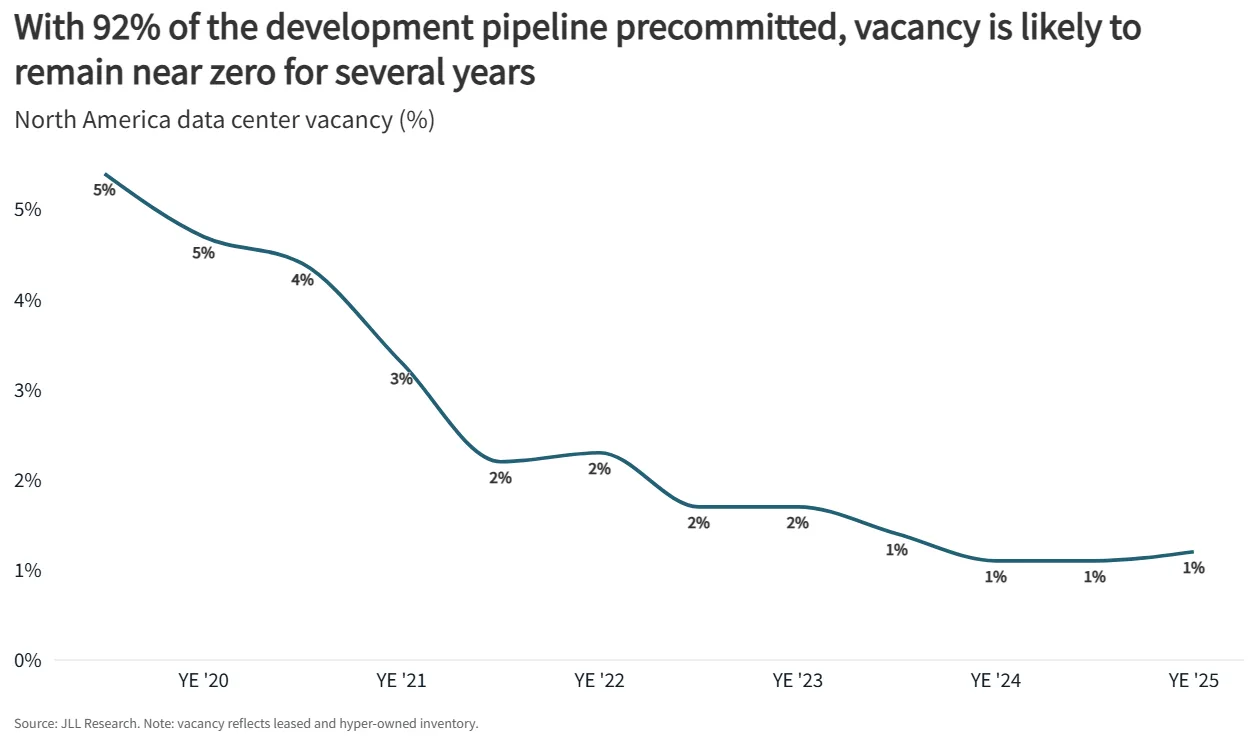
- Vacancy remains near 1% nationwide despite unprecedented development, with 92% of new capacity pre-leased.
- Rising land and construction costs are pricing out residential developers, worsening housing shortages in certain regions.
- Institutional investment and rent growth for data centers are accelerating, with the sector expanding rapidly into frontier markets.
Data Centers Drive Land Rush
Artificial intelligence demand and digital infrastructure needs are reshaping US commercial real estate, The WSJ reports. Data center growth is accelerating across major markets. Tech giants including Amazon, Microsoft, Meta, and Google are buying buildable land at record prices. They are especially active in Northern Virginia.
Meanwhile, data center operators are outbidding home builders and residential developers. They can pay millions per acre and close deals quickly. This shift is disrupting traditional land acquisition patterns. For example, Amazon paid $700M for a site in Prince William County, Virginia. Stanley Martin bought that same property for $50M several years earlier.
Land Constraints and Housing Shortages
This data center boom is coinciding with—and in some areas, intensifying—a critical undersupply of housing. Reports indicate Northern Virginia faces a shortage of over 75,000 homes. Local zoning and conservation restrictions further concentrate intense competition for available land, driving prices beyond the reach of most home builders.
Data center development has accounted for 20–30% of all land activity in Loudoun and Prince William Counties since 2013. From 2022 to 2024, there was 50% more data-center development in these counties than during the prior nine years combined. The competition has intensified as Amazon recently agreed to pay $700M for a large Virginia site tied to future data center expansion, underscoring how aggressively tech firms are pursuing scarce land.
Get Smarter about what matters in CRE
Stay ahead of trends in commercial real estate with CRE Daily – the free newsletter delivering everything you need to start your day in just 5-minutes
Development Pressures and Political Fallout
Residents and local officials are mounting resistance as data centers proliferate, citing community concerns over noise, increased power demand, and lost opportunities for housing. Some local boards have responded by tightening approval processes for new projects or proposing regulations favoring housing over further server farm expansion.
Meanwhile, the sector’s economic clout is evident, with data center companies making large political contributions and offering property owners and builders deals that far exceed residential land values. Many CRE experts warn these financial incentives could further crowd out housing.
Investment Rises as Vacancy Stays Low
According to JLL, data center vacancy rates have held at a record low of 1% for two consecutive years, challenging concerns about sector overbuilding. More than 35 gigawatts of new capacity—equivalent to the electricity use of the UK or Italy—are under construction in North America, with 92% of future space pre-leased or owner-occupied.
Hyperscalers now make up about 65% of demand, and rent growth since 2020 has exceeded 60% on average. Annual 3%+ lease escalations are common. Despite some caution about overheating, rising capital flows and complex joint ventures—like Blue Owl and Meta’s $30B deal—underscore continued institutional confidence in the sector’s long-term trajectory.
Frontier Markets and Future Outlook
The pattern of data center expansion is diversifying. Sixty-four percent of new capacity is being built in frontier markets such as West Texas, Tennessee, Wisconsin, and Ohio. Texas could surpass Northern Virginia as the nation’s largest market by 2030 due to abundant energy, land, and regulatory advantages.
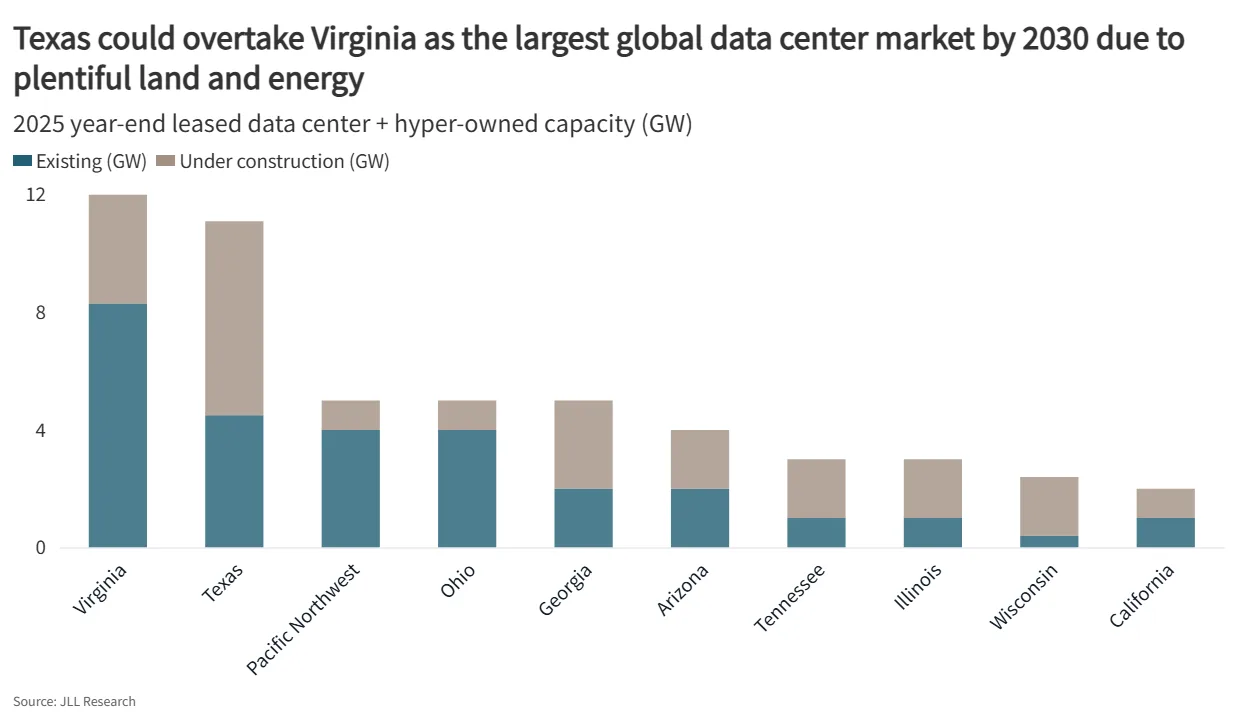
Developers face challenges including four-year-plus utility grid interconnection waits. Those able to self-supply energy through onsite generation can speed up timelines and gain competitive advantage. Overall, the US data centers sector is poised to remain in high demand for several years, fundamentally reshaping land use and property values across multiple markets.