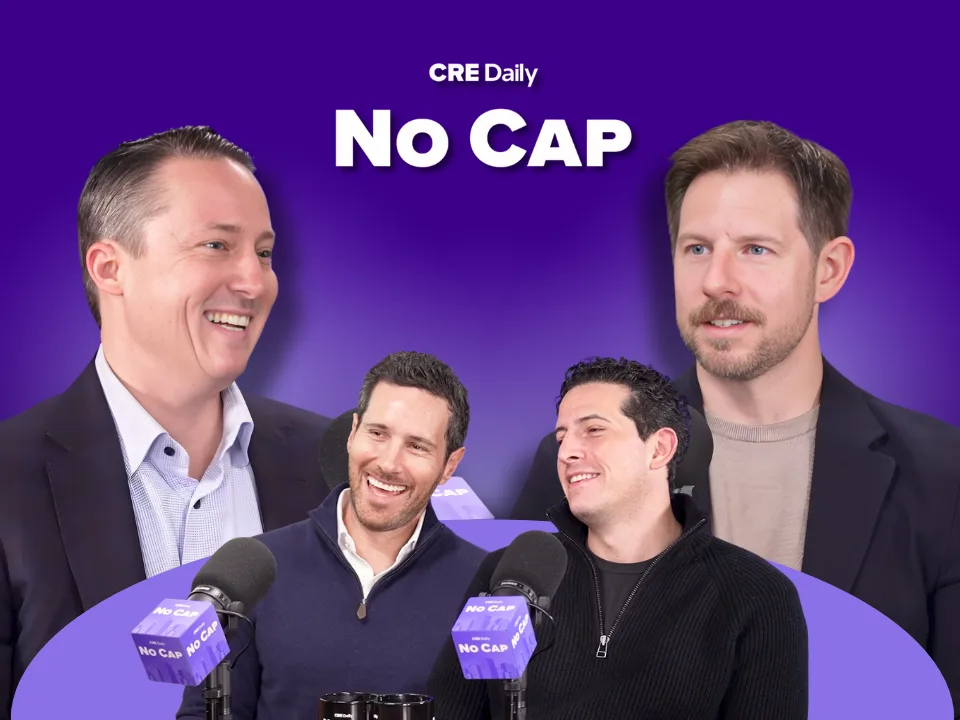


Season 5 of the No Cap podcast is sponsored by Bracket, and in this episode co-hosts Jack Stone and Alex Gornik sit down with the platform’s founders, Brandon Colombo and Rodes Boyd, to talk about the technology they believe will reshape commercial real estate transactions.
Bracket is building an end-to-end digital trading platform for commercial real estate—designed to streamline everything from prospecting to closing. In the conversation, Colombo and Boyd break down the inefficiencies that still dominate CRE transactions, what they learned building deals at 10X, and why they believe digital marketplaces will expand the buyer pool for commercial assets.
Conversation Highlights
Jack: Why don’t we start with the basics. What exactly is Bracket?
Brandon Colombo: We’re developing a full end-to-end trading platform for commercial real estate. Everything from prospecting to the closing table can happen inside the platform. Think of it as an operating system for investment sales brokers. They can run their entire process through Bracket, while buyers access deals through a marketplace.
Alex: What problem were you trying to solve when you started building it?
Rodes Boyd: The frustration with transactions in our business. Commercial real estate deals take forever. In residential, if a deal says it’s going to close in 30 days, it usually closes in 30 days. In commercial real estate, that almost never happens. One of the biggest issues is asymmetric information. Buyers and sellers don’t start with the same information, and the due diligence process drags everything out.
The founders’ previous experience working at 10X shaped how they approached the problem.
Jack: You both came from 10X. What did you learn there that influenced Bracket?
Brandon: At 10X we worked with brokers across the country. What we saw was that some brokers had incredibly sophisticated processes, while others didn’t really have a structured process at all. We would ask sellers for basic due diligence or financials and sometimes they just didn’t have it ready—even after a property had been marketed for months.
We would ask sellers for financials or due diligence that buyers needed, and they didn’t have it ready.
Jack: Auctions obviously changed part of the industry. What worked about that model?
Brandon: Auctions bring structure. Typically you have about a 45-day marketing period, 10% hard earnest money, and a 30-day close. That structure creates certainty. But it doesn’t work for every buyer.
Alex: Why not?
Brandon: Institutional investors often can’t move that fast. They need time for investment committee approvals. So if the process moves too quickly, those buyers simply can’t participate.
Because of that, Bracket supports multiple transaction structures rather than relying only on auctions.
Rodes: We believe every asset can eventually sell digitally, but the process needs to match the seller’s goals. Some deals make sense as auctions. Others work better as a call-for-offers process or a traditional listing. The goal is to give brokers flexibility while still running a structured process.
Brandon: Our brokerage was basically a test kitchen. We ran deals on every platform—10X, Crexi, RealINSIGHT—just trying to figure out what worked and what didn’t. What we realized is brokers are juggling a ton of disconnected systems. They’re pulling data from CoStar, underwriting in spreadsheets, managing documents, building offering memorandums—it’s fragmented. So we decided to build software that would bring the whole process together.
Originally the platform was built only for their own brokerage.
Brandon: At first it was just for us. But once we finished building it, we realized it was too valuable to keep for ourselves. Brokers everywhere have the same operational problems.
Rodes: We had a new broker list an owner-user office building in Ohio. The seller had high expectations, so we structured a call-for-offers process with clear deadlines. Two offers came in right on the deadline day, and now the deal is closing. From listing to closing, the deal took about 90 days—including roughly 45 days of marketing.
Another feature of the platform focuses on pricing transparency.
Rodes: We use AI to estimate value ranges based on comps, underwriting, and the quality of due diligence. If the due diligence is strong, the price goes up. If it’s weak, the price goes down—because that’s what buyers are going to do anyway. The goal is to align expectations earlier in the process.
Jack: One of the big issues in this business is simply getting deals in front of the right buyers.
Brandon: Exactly. A lot of deals only circulate within local broker networks. But there might be buyers across the country who want that asset and never see it.
If you’re selling a $3M industrial building in Richmond, there could be investors in Manhattan who would buy that deal…but the listing never reaches them.
Watch the full episode on our YouTube Channel or your favorite podcast app.
Tune in weekly for new episodes of No Cap by CRE Daily!